On Time, Every Time.
How do I choose a BBQ catering menu that actually pays?
Choose a BBQ catering menu by working backward from cost: pick a two-meat shape, apply 30 to 50% cook loss to your raw purchase weight, add about $1.10 per guest in consumables, add your labor at a real rate, then set the price. Do that and the buffet range of $15 to $30 per person stops being a guess and becomes arithmetic you can defend. The menu you pick is a cost decision wearing a food costume, and the sides are where the margin actually lives.
- Two meats covers nearly every eater; a third adds about 30% more total protein, not triple.
- Sides run $0.30 to $0.85 per serving against meats at $2 to $6 – the side lineup protects margin.
- Budget shape: pulled pork plus smoked chicken quarters, under $4 of meat cost per guest.
- Consumables (plates, napkins, cutlery, buns, sauce) run about $1.10 per guest.
- Smoked meats lose 30 to 50% of their weight between trim and pit – cost the cooked yield, not the sticker.
How do I choose a BBQ catering menu that actually pays?
Pick the shape that fits the event and the budget, then cost it out per guest before you name a price. Shape first, arithmetic second, price third. Never the other way round.
The chain catering pages you have been comparing sell tiers: one meat, two meats, three meats, price per head. That is a retail product, not menu design. It hides the two questions that decide whether the job pays: what each item costs you after cook loss, and how it behaves between your pit and their plates. Our BBQ catering guides are built around that second half.
A catering menu has three jobs: please almost everyone, hit a food cost you can price profitably, and survive the hold. Every candidate dish gets judged against all three.
The three shapes that cover almost every job
Pick your menu shape
Crowd-pleaserBrisket + pulled porkMac, slaw, beans, rollsMost-booked wedding menuBrisket carries the wowShowpieceThird meat: ribs or sausageCarving station or on-site rigAbout 30% more total proteinSmaller portions of each meatBudget saverPulled pork + chicken quartersBeans, slaw, cornbreadUnder $4 meat cost per guestNobody leaves hungry
Most events fall into one of three builds. Pick the shape, then swap items inside it.
The crowd-pleaser
Brisket and pulled pork, mac and cheese, coleslaw, baked beans, rolls. The most-booked wedding menu in BBQ. Pulled pork keeps food cost sane while brisket carries the wow.
The showpiece
A third meat – ribs or sausage – plus a carving station, or bring the rig for on-site presence smoke. Portions of each meat shrink; total protein rises roughly 30%.
The budget saver
Pulled pork plus smoked chicken quarters, or the quarter chicken plate: one leg quarter per person, beans, slaw, cornbread. Under $4 of meat cost per guest.
Drop-off corporate work changes the shape again. The boardroom box is sliced brisket or pulled pork sandwiches, slaw, chips, cookie – individually boxed, no service staff, premium price for zero hassle. The taco bar (pulled pork plus smoked chicken thighs, tortillas, fixings) is interactive, budget-friendly, and both meats hold beautifully in a cambro. More builds by event sit in our catering menu ideas guide.
Menu shapes compared, with meat cost per guest
Meat cost below assumes a packer brisket at $3.50 per pound and pork butt at $2.00 per pound, prices observed August 2026. Swap in your own invoice number and the rest of the math holds.
| Menu | Proteins | Meat cost per guest | Best for |
|---|---|---|---|
| Crowd-pleaser | Brisket + pulled pork | About $4.75 | Weddings, large parties |
| Showpiece | Three meats + carving station | About $6.20 (30% more protein) | Weddings with a display budget |
| Budget saver | Pulled pork + chicken quarters | Under $4.00 | Fundraisers, big headcounts |
| Boardroom box | Pulled pork sandwiches, boxed | About $2.00 | Corporate drop-off |
Full arithmetic for the crowd-pleaser row is worked below. The other rows scale from the same cook-loss method.
A worked 100-guest crowd-pleaser, start to price
From headcount to quoted price
Cooked meat needed33 lb brisket + 33 lb pork for 100 guestsRaw purchase weightcooked divided by 0.60 at 40% cook lossMeat costcost the raw weight, never the cookedSides$0.30 to $0.85 per servingConsumablesabout $1.10 per guestLaboryour hours at a real hourly rateQuotetotal cost plus the margin that pays you
Here is the whole job as numbers. Cook loss is taken at 40%, the midpoint of the published 30 to 50% range, so every raw weight below is a purchase figure, not a served figure.
Step 1: cooked meat needed
Two meats, roughly 1/3 lb cooked brisket and 1/3 lb cooked pulled pork per guest. That is 33 lb cooked brisket and 33 lb cooked pork for 100.
Step 2: raw purchase weight after cook loss
At 40% loss you keep 60% of what you buy, so raw = cooked ÷ 0.60. Brisket: 33 ÷ 0.60 = 55 lb raw, buy 56 lb (four packers). Pork butt: 33 ÷ 0.60 = 55 lb raw, buy 56 lb. Cost the 56 lb, never the 33 lb.
Step 3: meat cost
Brisket 56 lb at $3.50 per pound = $196. Pork 56 lb at $2.00 per pound = $112. Total meat $308, which is $3.08 per guest on paper. That $3.08 is the number that gets caterers into trouble, because three things sit between it and what you actually spend. Here is each one, priced.
1. Trim loss before the pit. The 40% figure is loss across the whole cook, but a packer sheds weight before it ever sees smoke. Figure roughly 2 lb of hard fat cap and deckle trimmed off a 14 lb packer, about 15% of the brisket gone at the trim table. To land 56 lb of trimmed brisket on the pit you are buying closer to 66 lb at the counter, which is $231 rather than $196, or $35 more.
2. The packer you buy because briskets do not come in 56 lb increments. You cannot order 56 lb, or 66 lb. You buy whole packers at whatever the case yields. Four 14 lb packers is 56 lb before trim, so covering the trim loss means a fifth packer: 70 lb at $3.50 = $245. Pork butts have the same problem in miniature, and the same answer – round up to whole cuts and cost the extra one, because the alternative is being short at 4pm.
3. The overproduction buffer. Add 10% on top of the rounded purchase for the guests who come back for seconds, the plate someone drops, and the final count that creeps up after the deadline. On roughly $245 brisket plus $120 of pork butts that is about $37.
Stack them: $245 brisket + $120 pork + about $37 buffer lands near $402 of meat for 100 guests, or about $4.75 per guest – the table figure, and roughly 54% above the naive $3.08. Cost the cooked yield, count the whole cuts you actually buy, and add the buffer, or you will underestimate food cost by nearly half.
Step 4: sides
Four sides at the midpoint of $0.30 to $0.85 per serving, call it $0.58: 4 × $0.58 = $2.32 per guest, or $232 for 100.
Step 5: consumables
$1.10 per guest × 100 = $110. Plates, napkins, cutlery kits, sauce cups, buns.
Step 6: labor
Say 18 hours across trim, overnight cook, pack, transport, serve and teardown, paid at $25 per hour = $450. Your hours are a cost before profit, not a rounding error.
Step 7: the number
Food $475 (meat at $4.75 per guest) + sides $232 + consumables $110 + labor $450 = $1,267, or $12.67 per guest at zero profit. That $12.67 is not the whole cost, only the part this worked example priced – the block below adds the line items it left out and restates the real per-guest figure. Price that job at $25 per person and you gross $2,500, and the gap is thinner than it looks once fuel, rentals, mileage, insurance and card fees come out. That is why the published $15 to $30 per person buffet range exists, and why the bottom of it is thin.
Treat these as planning estimates, not a guarantee. Your invoices decide the real figure, and the method for turning them into a defensible price sits in what to charge per person.
If you want this arithmetic run automatically against live menus, yields and your own costs, that is exactly what the catering calculator does.
Costs this page did not include
The $12.67 per guest above covers meat, sides, consumables and labor. It stops there. These are the line items that quietly come out of the same job, priced as planning estimates for the 100-guest crowd-pleaser.
- Wood and charcoal, one overnight cook: roughly $40 to $60 in splits or lump for a full pit running through the night, call it $50, or $0.50 per guest.
- Cambro and chafer rental or amortization: about $50 to $90 per event rented; owned gear amortizes to roughly $10 to $20 per job across its life. Budget $60, or $0.60 per guest.
- Mileage: a 60-mile round trip for shopping plus a 60-mile round trip on event day at the going per-mile rate is about $80, or $0.80 per guest.
- Liability insurance: an annual policy spread across the jobs you book, or a single-event policy, works out near $25 to $40 per event. Call it $30, or $0.30 per guest.
- Card processing at 2.9%: on a $2,500 invoice that is about $73, or $0.73 per guest, and it lands on the gross, not the profit.
Those five add roughly $293 to the job, about $2.93 per guest. The real cost is closer to $15.60 per guest than $12.67, and that is still before overhead and taxes. Read the $12.67 as the food-and-labor floor, not the finished number: at a $25 per person quote your margin is nearer $940 than $1,233. Cost up from your own invoices, then add the 25 to 35% margin on top.
Sides are the margin engine, not the filler
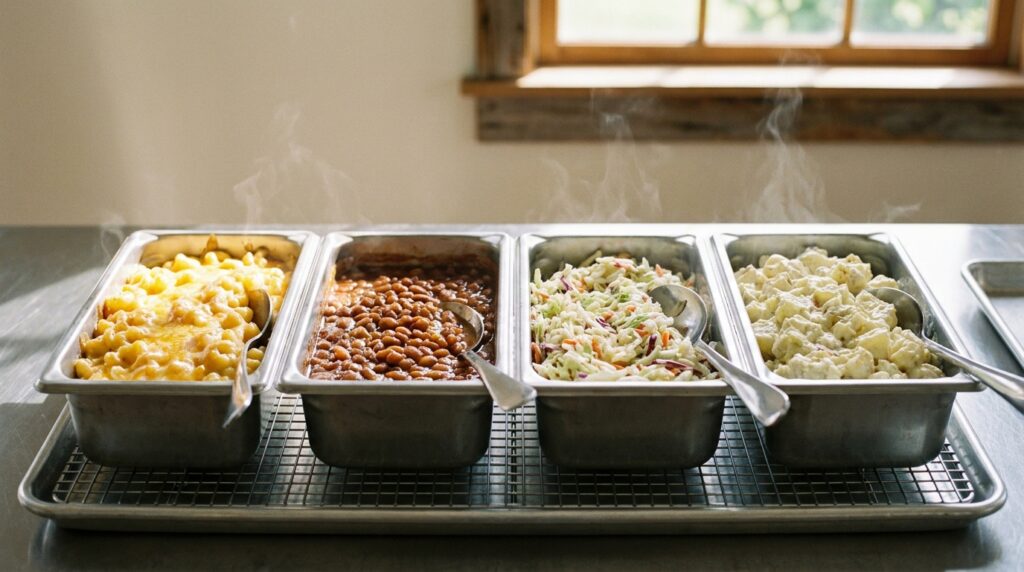
The belief most first-time caterers arrive with: sides are the cheap stuff that fills the plate. Half right. They are cheap, and that is precisely why every side that genuinely satisfies is margin you keep rather than spend.
The holy quartet is mac and cheese, baked beans, coleslaw and potato salad, plus cornbread or rolls, covering about 90% of events. Three of those four are make-ahead, and make-ahead sides beat day-of sides for catering logistics every time.
Design the menu around the hold, not the pit
Every dish has to survive the gap between your pit and their plates. That gap is the real menu filter.
Pulled pork is the ideal catering meat: cheap, nearly impossible to overcook, holds for hours, universally liked. Brisket brings the wow but punishes timing mistakes, and it gets sliced at service, never before. Ribs and chicken need to land close to serve time because bark and skin die in a long hold. First paid job? Our guide to catering your first paid party makes the case for pulled pork plus one forgiving second meat, two make-ahead sides, buns and sauce.
USDA safe internal temperatures apply on a job exactly as in your backyard: 145F for whole cuts of pork and beef, 165F for poultry, and hot food held above 140F.
When 100 guests eat 115 plates
Cook loss is the shrink everyone models. Portion creep is the one that quietly eats the margin: a 100-guest job that serves 115 plates because people go back for seconds, because the count crept up after the deadline, and because a self-serve line lets the first forty guests take a caterer’s portion instead of a guest’s. You bought for 100 and you fed 115, so every per-guest cost on this page just went up by roughly 15% while the invoice stayed the same.
The 10% overproduction buffer priced in step 3 is a cushion, not a plan. It absorbs a dropped plate and a few late additions. It does not absorb an unmanaged buffet. Three defenses do the actual work:
- A final count deadline in writing, plus 10% overproduction. Set the deadline far enough out that you buy against a real number, state that the count can go up but not down after it, and cook 10% over that confirmed figure. The deadline is what makes the buffer meaningful instead of a guess stacked on a guess.
- Your own staff on the meat line. Sides can be self-serve; the $2 to $6 per pound items should not be. One person portioning brisket and pork is the single cheapest control you can buy, and it costs less than the meat it saves. Seconds still happen, they just happen after everyone has been served once.
- Pre-portioned builds where the format allows. Sandwiches assembled to a set weight, boxed drop-off lunches, and the quarter chicken plate all fix the portion at the pack table instead of leaving it to the tongs. The boardroom box in the table above is the clearest case: one guest, one box, no creep.
Price the defense in rather than hoping it does not happen. If the event is a self-serve buffet with no staff on the line, either quote the labor for a server or plan protein closer to 115% of the headcount and put that in your cost, the same way the two-meat menu already plans about 115% of a single-meat total because people take some of each.
Size the cook before you quote the menu
Menu shape decides quantities, and quantities decide whether you are two butts short at 4pm. Run the headcount first.
Then put the menu in writing. The contract lists smoked meats and sides exactly as quoted, plus what is not included unless separately contracted: rentals, alcohol service, cake cutting. Site requirements belong there too – level vehicle access for the rig, power, and fire clearance for on-site smoking. The seven clauses to copy and send has the wording.
Frequently asked questions
How many meats should a BBQ catering menu have?
Two. Two proteins covers nearly every eater at a buffet. A third adds about a 30% bump in total protein rather than tripling it, because portions of each shrink, so treat the third meat as a variety and visual upgrade you charge for, not as more food.
What is the cheapest BBQ catering menu that still feels generous?
Pulled pork plus smoked chicken quarters, or the quarter chicken plate: one leg quarter per person with beans, slaw and cornbread. Both land under $4 of meat cost per guest and nobody feels shorted.
How much should I charge per person for BBQ catering?
Buffet with two meats and two or three sides typically runs $15 to $30 per person; plated service and premium cuts reach $35 to $60+. Weddings run $20 to $45 per guest. Build your own number from your costs rather than matching a competitor.
How much brisket do I buy for 100 people?
For a third of a pound cooked per guest across a two-meat menu, you need 33 lb cooked, which is about 56 lb raw once you allow 40% cook loss. Buy the raw weight, cost the raw weight.
What is the most popular BBQ wedding catering menu?
Brisket and pulled pork with mac and cheese, coleslaw, baked beans and rolls, and BBQ overall runs 30 to 50% cheaper than a plated hotel dinner. Quantities and timeline are in our wedding catering guide.
Your pre-quote checklist
- Confirm the headcount in writing, with a final-count deadline.
- Pick the shape: crowd-pleaser, showpiece, budget saver, or boxed drop-off.
- Run cook loss at 30 to 50% to get raw purchase weight, then cost that weight.
- Add sides at $0.30 to $0.85 per serving.
- Add consumables at about $1.10 per guest.
- Add your labor hours at a real hourly rate.
- Only now, quote – your cost plus the margin that pays you.
Written by John Kirker, who built the first meat smoking calculator in 2011. Times come from cooks we have actually run and logged; temperature and feel decide the finish, never the clock alone.
Reviewed by John Kirker, Founder, John Kirker Inc. - last updated August 29, 2026.
Sources for this article
- Crowd-pleaser menu: brisket + pulled pork, mac and cheese, coleslaw, baked beans, rolls - most-booked wedding menu
- Third meat = about a 30% bump in total protein, not triple
- Budget saver: pulled pork + smoked chicken quarters, under $4 of meat cost per guest
- Quarter chicken plate: one leg quarter per person, beans, slaw, cornbread, under $4 meat cost
- Sides $0.30 to $0.85 per serving; meats $2 to $6
- Holy quartet of sides covers 90% of events; make-ahead sides win
- Consumables about $1.10 per guest
- Buffet two meats + two or three sides: $15 to $30 per person; plated/premium $35 to $60+
Facts drawn from this site's own documented knowledge and first-hand experience.

Rated 5by 500+ users
Tagline
Other Options
The MeatSmokingCalculator will help you plan the timeline for any meal.
Planning, ingredients, preparation, and timing are the most critical elements to making and serving great food.
Having enough time is the most important part when it comes to slow and low!
Meat Smoking Calculator takes the thinking out of the process.
It makes cooking and serving amazing tasting smoked meats every time, on time.
SOME OF OUR FAVORITE SITES
Smoking a Turkey for Thanksgiving!
BBQ Brethren
Smoking Meat Forums
Deejay’s Smoke Pit
USDA’s Food Safety Guidelines
Smoking Pit
Virtual Weber Bullet
Smoking Times and Temps
* To help support this free site, posts contain affiliate links. If you use one of the affiliate links, we may earn a commission at no additional cost to you. As an Amazon Associate I earn from qualifying purchases.