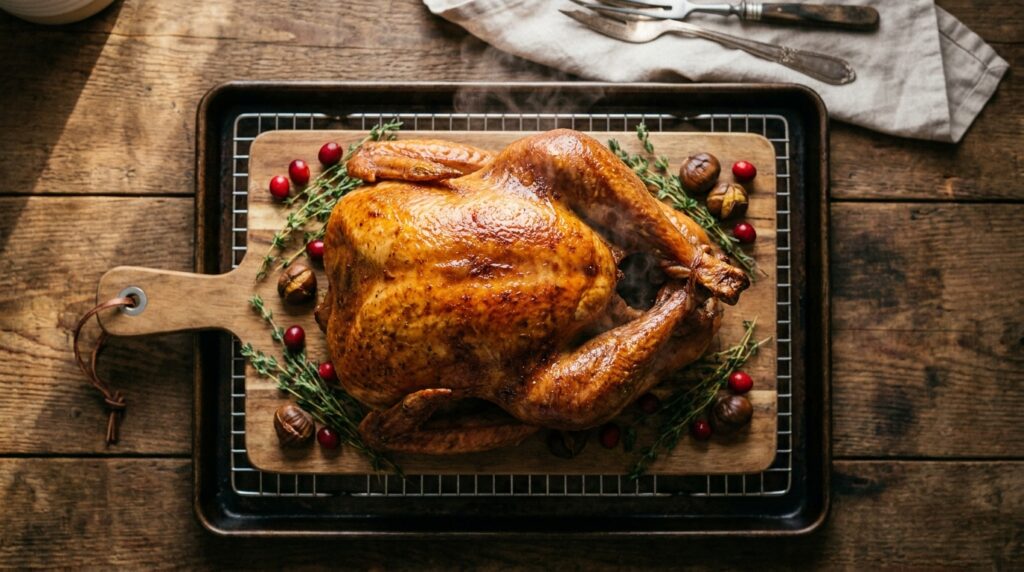
On Time, Every Time.
Smoking Turkey Times and Temps
Updated 2026. This is our original turkey method from 2014 and it still works. The numbers the calculator uses today: a whole turkey at 225°F runs about 25 minutes per pound and a breast about 37 minutes per pound; the bird is done when the breast reads 165°F and the thigh 175°F. Brine first, run the pit hot enough for the skin, and plan the cook backward from dinner:
For Great Tasting Thanksgiving Turkey Every Time!
We’ve had a few requests for Turkey Smoking Instructions on our MeatSmoking Facebook Page.
So we figured we’d share our “secret” recipe… 🙂
For starters, we’re big fans of brining foul. Brining will plump up the bird and give it some base flavor.
There are all kinds of brining recipes, but here’s how we do it.
We line a 5 gallon Home Depot bucket with a food grade plastic liner. In a pinch I’ve used garbage bags but some people are concerned with BPA’s and I understand it.
We then combine 1 gallon of refrigerated bottled water, and 1 gallon of refrigerated apple juice (fresh pressed preferred) and 1 to 1.5 cups of Kosher salt. (1. DO NOT BRINE DIRECTLY IN A METAL CONTAINER AS THE SALT CAN REACT WITH CERTAIN METALS AND YOUR BIRD CAN TASTE FUNKY! 2) Refrigerated liquids will help keep the bird out of the danger zone in an attempt to slow any bacteria growth.)
Allow the salt to dissolve in the mixture by stirring it up a bit.
Once the majority of the salt has dissolved, rinse your completely thawed turkey and place it into the mixture. You want to make sure the bird is completely submerged. You can twist the garbage bag and then place a plate on top of the bird to add some weight to it in an attempt to keep it submerged. (I usually submerge the bird neck-side up.)
Place the bucket into the fridge and let it sit for 6-24 hours. You can play with the brining time. I have a friend who is one of the top chefs in the nation. He brines his turkeys for 7 days and serves them at the hotel. They do about 600 birds each year. It’s unheard of but he swears by it. I typically do a 3-4 day brine..
Once your brining time is up, remove the turkey from the mixture and dispose of it. Remember, you are working with foul so do what you can to keep things clean. Rinse the bird and put it out on some tin foil or a baking sheet so that you can apply the rub. Pat the bird dry.
For the rub, mix up the following ingredients:
- 1 tablespoon of garlic powder
- 2 teaspoons of Lawry’s Seasoning Salt
- 1 teaspoon of Poultry seasoning
- 1 teaspoon of paprika
- 1/2 teaspoon of fresh cracked pepper
- 1/4 teaspoon of cayenne pepper
- 1/4 teaspoon fresh ground basil
I’m a big fan of fresh herbs and spices so if you can get ’em great. If not, use what you can find.
Generously rub the bird with the mix. You may have to time-and-a-half the rub recipe for a larger bird. Don’t be scared to use too much. 😉
Now, put two whole sticks of butter into the butt of the bird and place it into the smoker breast side down for the first 2/3 of the cook. After that, flip the bird breast side up for the remainder of the time.
Thank You,
John Kirker
I know more about women then BBQ – and according to my wife, I don’t know much about women!
Click here to Figure Out Your Cooking Timeline!
This chart is provided for educational and informational purposes only. While we strive for accuracy, this information should not be used as a substitute for official food safety guidelines. When smoking meat, always use a reliable meat thermometer and follow established safe internal temperature guidelines. We strongly recommend following the food safety guidelines provided by the FDA. For complete and up-to-date food handling recommendations, please visit: FDA Safe Food Handling Guidelines Data in this chart is derived from peer-reviewed studies and government guidelines. Times shown are D-values (time for 1-log or 90% reduction). For complete pathogen elimination, multiply by 6-7.Pathogen Thermal Death Curves (D-values)
🥩 Meat Smoking Safety Tips:
🔬 Pathogen Categories:
⚠️ Important Notes:
📋 Disclaimer from MeatSmokingCalculator.com
📚 Scientific References:
FAQ
How long does it take to smoke a turkey?
About 25 minutes per pound at 225°F for a whole bird, so a 14 lb turkey runs close to 6 hours; a bone-in breast runs about 37 minutes per pound. Spatchcocking or running the pit at 275°F shortens it. The thermometer decides: breast 165°F, thigh 175°F.
What temperature should a smoked turkey be when done?
165°F in the thickest part of the breast and at least 175°F in the thigh. Pull at those numbers and rest 20 to 30 minutes; carryover adds a few degrees. Cooking the breast past 165°F is what dries a turkey out.
Should I brine a turkey before smoking it?
Yes. A wet brine of 1 gallon of cold water, 1 gallon of cold apple juice and 1 to 1.5 cups of kosher salt for 6 to 24 hours plumps the bird and seasons it through, and it keeps the breast forgiving if you overshoot. Never brine in a bare metal container; use a food-grade liner or a plastic bucket.
What temperature do you smoke a turkey at?
225°F for maximum smoke, but the skin comes out rubbery at that temperature unless you finish hot. Many pitmasters run 275 to 325°F for a bird, which crisps the skin and finishes a 14 lb turkey in 3 to 4 hours; the internal targets do not change.
How big a turkey can you smoke?
Up to about 20 lb before it spends too long in the danger zone; above that, smoke two smaller birds, which also cook more evenly. A 12 to 14 lb bird is the sweet spot for a smoker, and a spatchcocked bird of any size cooks faster and more evenly than a whole one.
Written by John Kirker, who built the first meat smoking calculator in 2011. Times come from cooks we have actually run and logged; temperature and feel decide the finish, never the clock alone.

Rated 5by 500+ users
Tagline
Other Options
The MeatSmokingCalculator will help you plan the timeline for any meal.
Planning, ingredients, preparation, and timing are the most critical elements to making and serving great food.
Having enough time is the most important part when it comes to slow and low!
Meat Smoking Calculator takes the thinking out of the process.
It makes cooking and serving amazing tasting smoked meats every time, on time.
SOME OF OUR FAVORITE SITES
Smoking a Turkey for Thanksgiving!
BBQ Brethren
Smoking Meat Forums
Deejay’s Smoke Pit
USDA’s Food Safety Guidelines
Smoking Pit
Virtual Weber Bullet
Smoking Times and Temps
* To help support this free site, posts contain affiliate links. If you use one of the affiliate links, we may earn a commission at no additional cost to you. As an Amazon Associate I earn from qualifying purchases.