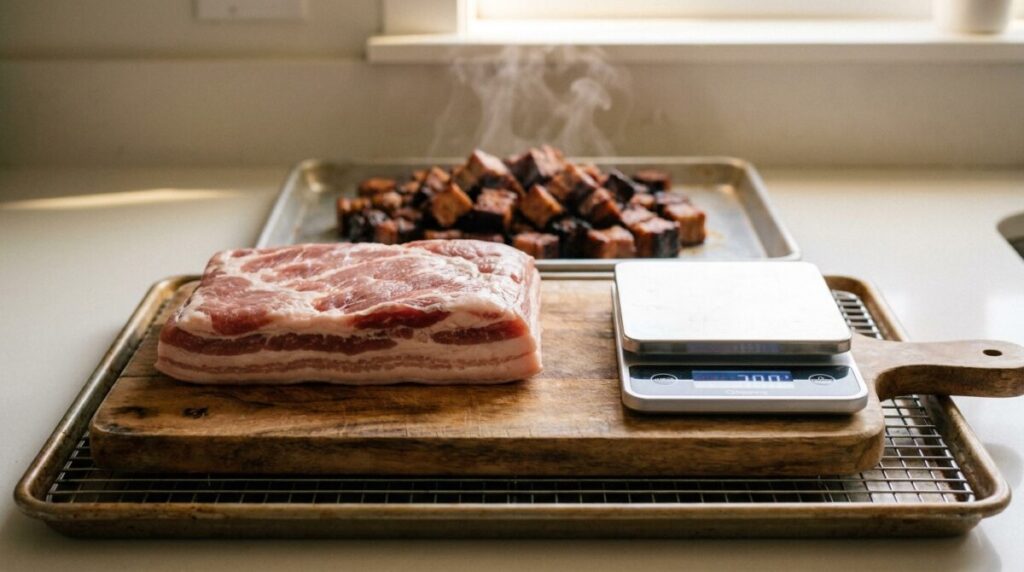
On Time, Every Time.
How Much Pork Belly Per Person? 0.33 lb Cooked, 0.57 lb Raw
Plan on 0.33 lb of cooked pork belly per person, which means buying about 0.57 lb of raw belly per person. Belly is one of the highest-loss cuts on the pit: about 10% goes to trim, then roughly 35% of what remains renders away. That leaves about 58.5% of the raw slab on the plate. A 9.3 lb slab, the typical weight logged on this site, lands near 5.4 lb cooked, or about 16 servings alongside other food. If belly is the only protein, cut that headcount roughly in half.
- 0.33 lb cooked per person when belly is served with sides or other meats.
- Raw to buy = cooked needed divided by 0.585 (10% trim loss, then 35% cook loss).
- Cubed burnt ends lose more than a whole sliced slab: budget nearer 40% cook loss on cubes, nearer 30% on a thick sliced slab.
- Whole slab: 250F, about 45 min/lb, pull at 200F. Burnt ends: 250F, about 3 hours, pull at 200F.
- Rest about 30 minutes either way.
How much pork belly per person
Plan 0.33 lb of cooked pork belly per person served with sides or a second meat, which is about 0.57 lb of raw slab bought per person. Belly is as rich as pork gets, and almost nobody eats half a pound of rendered belly and asks for seconds.
The number most people arrive with is half a pound per adult. That rule is real and it lives on our how much meat per person guide, but it is built for leaner main-event cuts. A third of a pound of belly eats like a half pound of shoulder. If you want the leaner counterweight on the same menu, run a pork butt for pulled pork next to it and let the belly play the rich role.
Raw weight to buy, not cooked weight
From headcount to raw belly to buy
This is where the arithmetic goes sideways. The 0.33 lb figure is cooked, served weight. Multiply the two losses: 0.90 x 0.65 = 0.585. Roughly 58.5% of the raw slab reaches the plate, so divide your cooked target by 0.585.
| Guests | Cooked meat needed | Raw belly to buy | Slabs at 9.3 lb |
|---|---|---|---|
| 4 | 1.3 lb | 2.3 lb | part of one |
| 10 | 3.3 lb | 5.6 lb | 1 |
| 20 | 6.6 lb | 11.3 lb | 1 to 2 |
| 30 | 9.9 lb | 16.9 lb | 2 |
| 50 | 16.5 lb | 28.2 lb | 3 |
| 100 | 33 lb | 56.4 lb | 6 |
A 9.3 lb pork belly slab yields about 5.4 lb of cooked meat, which serves roughly 16 people at a third of a pound each.
If belly is the only protein on the table, move to 0.5 lb cooked per person and buy about 0.85 lb raw each. Most hosts never need this. Belly is almost always a supporting act.
Skin-on versus skinless changes your trim loss
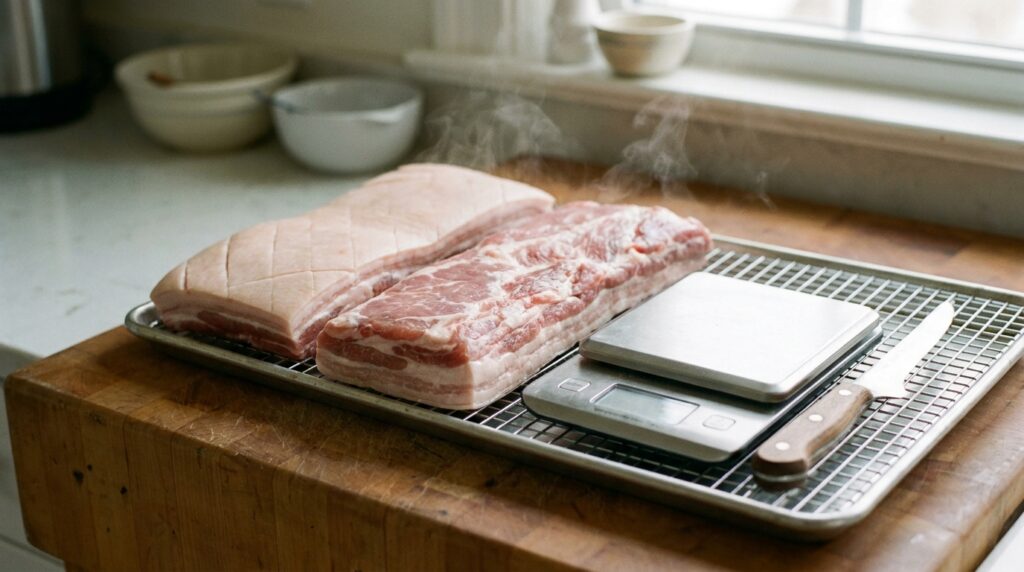
The 10% trim figure is the blended number. It splits in practice, and the split decides which slab is actually cheaper.
A skinless slab, already scalped at the plant, gives up close to nothing but square-up scraps and the odd soft edge, so trim loss sits at the low end of that 10%. A skin-on slab makes you pull the rind and the hard fat under it, and that comes off the top before any of the cook-loss math starts. Skin-on slabs usually price lower per pound, but you are buying pounds you will throw away, so compare on cost per served pound: divide the sticker price by 0.585 for skinless, and by a lower yield figure once you have weighed your own rind off.
The honest move is to weigh the skin the first time you trim one. Do it once and you will know forever whether your butcher’s skin-on price is a discount or a rebate on garbage.
Burnt ends versus whole slab: different loss, different count
Whole slab versus burnt ends
A single yield constant for both formats is the mistake this page exists to fix. Cubes and a whole slab do not lose the same.
Cube a slab into burnt ends and you multiply the surface area several times over, then sauce and hold the cubes back on heat until they tighten. More exposed surface plus more time equals more render out. Budget the top of the range on cubes, nearer 40% cook loss, which drops your served yield to roughly 54% of raw. A thick-sliced whole slab, cooked at about 45 min/lb and pulled at 200F, keeps more of itself: nearer 30% cook loss, or about 63% served yield.
Whole slab, sliced
250F, about 45 min/lb, pull at 200F, rest 30 minutes. Lower end of the cook-loss range, and you control slice thickness, so portions hold to plan.
Burnt ends, cubed
250F, about 3 hours, pull at 200F. Top of the cook-loss range. Cubes also get grazed off a tray, so buy 10 to 15% over your headcount math if they go out early.
Practical version: if the belly is an appetizer going out while the main meat rests, plan 0.2 to 0.25 lb cooked per person and buy on the burnt-end yield. If it is a listed menu item, use the full 0.33 lb.
What our logged cooks actually measured
The slab-size figures here come from 358 pork belly cooks logged by users in our calculator, where the weight entered is the raw purchase weight before trimming, not a post-trim or cooked weight. Typical entry: 9.3 lb, range 1.0 lb to 12.0 lb, overwhelmingly slow and low. Those are self-reported shopping weights, not our scale readings, so treat them as what people buy rather than what they serve.
That range is the useful part. There is no standard pork belly. A 1 lb piece and a 12 lb piece are both labeled the same at the counter, so buy by the pound against the table above, never by the piece. The practical ceiling is whatever your pit holds flat, and a 12 lb slab is long.
We do not log trimmed or cooked weights from users, which is exactly why the cook-loss splits above are stated as ranges rather than a single decimal. If you weigh your slab raw, after trim, and after the rest, send the three numbers and we will tighten this page with real data.
Scaling up: when belly joins a bigger menu
Belly rarely stands alone for a crowd. Our 50, 100, and 200 guest buy lists assume about 6.5 oz of cooked meat per person plus sides, with 15% buffet overage. Split that across two meats and belly carries maybe a third of the load.
At the far end, the same backward math runs on whole hog roast catering: a dressed hog yields about 40% of its weight as served meat, so a 100 lb hog gives about 40 lb and feeds 80 to 100 with sides. Belly, hog, brisket. Every cut is planned backward from cooked weight through its own yield.
Cooking it so the yield math holds
All of this assumes you render the fat. Pulling belly at 185F leaves unrendered fat that reads as weight on the scale and as grease on the plate, and guests eat less of it. That is a yield loss too, just one that happens in the trash instead of the drip pan.
- Weigh the slab raw, then again after trim, so you know your own loss.
- Run the pit at 250F for both whole slab and burnt ends.
- Budget about 45 min/lb for a whole slab, about 3 hours for cubed burnt ends.
- Pull at 200F internal, not before.
- Rest about 30 minutes before slicing or saucing.
- Apple, cherry, hickory, peach, or pecan for wood.
USDA lists 145F with a 3 minute rest as the safe minimum internal temperature for whole cuts of pork. Belly runs far past that for texture, not safety. To land the finish on a serving hour rather than “whenever it is done,” work backward with our roast calculator for smoked meat. These are planning estimates, not guarantees, since slab thickness and pit behavior both move the clock.
Frequently asked questions
How many people does a 3 lb pork belly feed?
About 5 people as a side or second meat. A 3 lb raw slab yields roughly 1.75 lb cooked at 58.5% blended yield, which is five servings at 0.33 lb each. Cubed for burnt ends, expect closer to 1.6 lb cooked and four to five servings. Call it 3 to 4 people if belly is the main protein.
How much raw pork belly per person should I buy?
About 0.57 lb raw per person for a 0.33 lb cooked serving. The math is 0.33 divided by 0.585, where 0.585 accounts for about 10% trim loss and about 35% cook loss. For burnt ends specifically, use a lower served yield near 54% and buy closer to 0.61 lb raw per person.
Is half a pound per person right for pork belly?
Not usually. Half a pound of cooked meat per adult is the rule for leaner main-event cuts like brisket or pulled pork. Belly is fat-forward, so a third of a pound per person is the realistic figure unless belly is the only protein on the table.
Should I buy skin-on or skinless pork belly?
Skinless if you are buying to a headcount, because the trim loss is at the low end and the yield math is predictable. Skin-on is usually cheaper per pound, but the rind and hard fat come off before the cook, so compare cost per served pound rather than sticker price per pound.
Does pork belly lose more weight than pork butt?
Yes, on the cook. Belly runs about 10% trim loss plus roughly 35% cook loss, leaving about 58.5% of raw weight on the plate, and cubed burnt ends land lower still. Plan 0.33 lb cooked per person and buy raw accordingly.
What temperature do I pull pork belly at?
200F, for both a whole slab and burnt ends, smoked at 250F, then rested about 30 minutes. USDA’s safe minimum for whole pork cuts is 145F with a 3 minute rest, but belly needs the extra cooking to render properly.
Written by John Kirker, who built the first meat smoking calculator in 2011. Times come from cooks we have actually run and logged; temperature and feel decide the finish, never the clock alone.
Reviewed by John Kirker, Founder, John Kirker Inc. - last updated October 5, 2026.
Sources for this article
- 0.33 lb cooked per person planning figure - ENGINE Pork Belly timings
- ~10% trim+bone loss and ~35% cook loss - ENGINE Pork Belly timings
- Whole slab: 250F, ~45 min/lb, pull 200F - ENGINE Pork Belly timings
- Burnt ends: 250F, ~3h, pull 200F - ENGINE Pork Belly timings
- Rest ~0.5h - ENGINE Pork Belly timings
- Best woods apple, cherry, hickory, peach, pecan - ENGINE Pork Belly timings
- 358 cooks logged, typical 9.3 lb, range 1.0-12.0 lb, slow-and-low - USAGE pork-belly
- Half a pound cooked per adult when meat is the main event; a third of a pound with heavy sides or multiple meats - POST How Much Meat Per Person
Facts drawn from this site's own documented knowledge and first-hand experience.

Rated 5by 500+ users
Tagline
Other Options
The MeatSmokingCalculator will help you plan the timeline for any meal.
Planning, ingredients, preparation, and timing are the most critical elements to making and serving great food.
Having enough time is the most important part when it comes to slow and low!
Meat Smoking Calculator takes the thinking out of the process.
It makes cooking and serving amazing tasting smoked meats every time, on time.
SOME OF OUR FAVORITE SITES
Smoking a Turkey for Thanksgiving!
BBQ Brethren
Smoking Meat Forums
Deejay’s Smoke Pit
USDA’s Food Safety Guidelines
Smoking Pit
Virtual Weber Bullet
Smoking Times and Temps
* To help support this free site, posts contain affiliate links. If you use one of the affiliate links, we may earn a commission at no additional cost to you. As an Amazon Associate I earn from qualifying purchases.