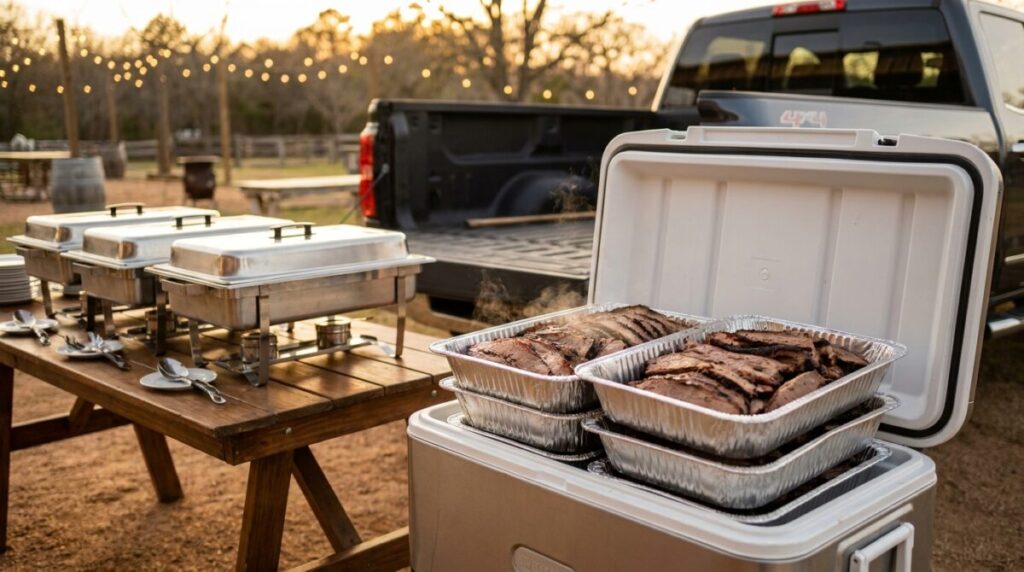
On Time, Every Time.
How to Get BBQ Catering Clients: The Marketing That Actually Books Events
You do not need an ad budget to get BBQ catering clients. For a small pit operation, three free things book the first year: a Google Business profile, a Facebook page with real photos of real jobs, and asking every happy client for a review and a referral. Weddings and corporate lunches book on trust, and trust compounds. The logo, the trailer wrap, the paid campaign – those are decoration you buy later, out of profits, if at all.
- Three free channels carry year one: Google Business profile, Facebook page, referral asks.
- Ask for the referral at pack-out, before the check clears, in one specific sentence.
- Book three paid jobs before you invest in gear. Do not buy a trailer.
- Save every quote. A price library turns a 2-hour quoting session into 10 minutes.
- You know it is a business when people you do not know start calling.
The belief you arrive with, and why it costs you jobs
Most new caterers assume clients are won with reach: more followers, more posts, a slicker website. They are not. Catering is a high-trust purchase where one bad decision ruins somebody’s wedding, so buyers hunt for proof, not polish.
Proof is a review with a real name on it, a photo of a full chafing line at a job that actually happened, and a written quote that lands fast. That is why marketing sits at step five in our guide to starting a BBQ catering business, not step one. You cannot market a job you have not proven you can execute.
Validate first: three paid jobs before any marketing
Book three paid jobs – friends-of-friends parties, an office lunch, a graduation. If you can price them profitably, execute them without chaos, and strangers start calling, you have a business. If every job still feels like a favor, you have a hobby, and that is a fine thing to have.
Those three jobs are also your entire content library: photos, testimonials, a menu you have cooked at volume. The full path from first party to paid operation lives in the BBQ catering guides hub, which covers pricing, quantities, holding, and the compliance stack.
Channel one: Google Business profile, set up in an hour
This is where “bbq catering near me” lands, it is free, and the reviews you collect live there permanently. Set it up the week after your first paid job, not before.
- Primary category: Caterer. Add “Barbecue Restaurant” only if you also sell food to the public somewhere legal to do so.
- Set a service area, not a storefront address, if you cook from home. Start with a radius you will genuinely drive – 30 miles is a common working limit, and travel gets priced into every quote anyway.
- First five photos, in this order: the full chafing line at service, sliced brisket on the board, the pit running at dawn, a plated portion with sides, you in an apron next to the smoker.
- Hours you will actually answer the phone, plus a working call button.
- One short service description naming your top three menus and your maximum headcount.
Why this order of photos: buyers are checking whether you can feed a room, not whether you can cook one brisket. The service line answers their real question in half a second.
Channel two: a Facebook page that shows work, not opinions
Post once per job, plus one prep or pit photo in between. Roughly two to four posts a month is enough. Frequency is not the lever, evidence is – event organizers screenshot job posts and send them to whoever signs the check.
A job post should contain four things: headcount served, the menu, one photo of the service line, and a line of thanks naming the host or the venue if they are fine with it. No stock brisket, no rub bottles on cutting boards. If you cannot show the job, do not post that day.
Channel three: the referral ask, said out loud at pack-out
The moment is pack-out, while you are loading coolers and the host is still full and happy – and before the check clears. Once money changes hands, the conversation turns transactional and the compliment cools off.
Say it verbatim: “Glad it went well. Two favors – if you’d leave a quick Google review while it’s fresh, that’s how people find me. And if you know anyone with a party or an office lunch coming up, send them my number.”
Copy-paste follow-up text, sent the next morning: “Thanks again for having us out Saturday – 90 guests and we packed out clean. If you have two minutes, a Google review helps a small operation like mine more than anything else I could pay for. Here’s the link: [your review link]. And if anyone asks who catered it, I’d appreciate the pass along.”
What a real booking chain looks like
In March 2026 a 140-guest corporate picnic came in from a single Facebook comment on a graduation-party post from the previous May. The office manager had been a guest at that graduation. Menu was brisket, pulled pork, two sides and rolls, quoted at $22 per guest for $3,080. After cooked-yield meat costs, seasonings at $0.25 per raw pound, consumables at about $1.10 per guest, travel and roughly 11 hours of labor beyond pit time, it netted inside the 25 to 35% margin band we teach.
Two more things came out of that one job. The picnic photos became the top five images on the Google profile, and one attendee booked a 60-guest rehearsal dinner in June off a referral asked for at pack-out. That is the whole engine: one job, photographed and asked about correctly, produces the next two.
A single referral asked for at pack-out costs nothing and converts better than any ad budget a small pit operation can afford.
Speed of quote is a marketing channel
Small operations lose jobs to slowness more than to price. A corporate planner emails four caterers on Tuesday and books whoever answers clearly by Thursday. If quoting takes two hours of scratch math, you answer last.
The fix is a price library. Save every quote you write, because repeat menus and stored pricing turn a 2-hour quoting session into 10 minutes. The same menus come back over and over: pulled pork and two sides for 60, brisket and chicken for 120. Build the file once, reuse it forever.
A quote email you can send tomorrow
“Hi [Name] – thanks for thinking of us for [date]. For [headcount] guests I’d suggest [menu: meat one, meat two, two sides, rolls], served hot on chafing dishes at [serve time]. That comes to $[X] per guest, $[total], which includes meat, sides, seasonings, serving consumables, setup, and travel to [location]. I hold the date on a signed confirmation and a deposit. Want me to lock in [date]?”
The failure mode that kills new caterers is not slow marketing, it is pricing off the raw meat sticker. Smoked meats lose 30 to 50% of raw weight, a 100-guest job runs 10 to 12 hours beyond pit time, and you still owe seasonings at $0.25 per raw pound and consumables at about $1.10 per guest before a 25 to 35% margin. Booking jobs you lose money on is worse than booking nothing.
What to say when someone asks “what would you charge?”
This question starts most BBQ catering businesses, and it usually arrives at a party, verbally, with a beer in hand. The wrong answer is a number pulled from air. The right answer: “Send me the date, headcount, and location and I’ll have a written quote to you tomorrow.”
That sentence buys time to cost the job properly, signals you are a business, and moves the deal into writing. Then run the math the way our walkthrough of catering your first paid party does and send inside 24 hours.
Corporate and wedding work: different doors, same key
Corporate lunches repeat and book on reliability. One office manager who trusts you is worth a dozen one-off parties, as the March picnic proved twice over. Weddings pay better per head, but the buyer is nervous, so photos of similar-size events do the selling.
Both come from the same referral engine. The office manager was at somebody’s graduation party. That is why every job is a marketing event whether you treat it like one or not.
The most underrated marketing spend here is not a website, it is holding capacity. Insulated coolers or a cambro let you cook ahead and hold above 140 degrees, which means you can say yes to a bigger job without a second smoker. Roughly $400 to $600 beyond the pit covers a legitimate 100-guest capability, and holding is the upgrade that pays for itself immediately.
When to spend money on marketing
Spend when your calendar has gaps referrals cannot fill, and not before. Capital follows revenue in this business. The trailer rig, the branded canopy, the second smoker, the commercial slicer – all real upgrades, all purchasable from profits once the bookings prove the need.
| Effort | Cost | Books jobs? | When to do it |
|---|---|---|---|
| Google Business profile | Free | Yes, for local search | After job one |
| Facebook page with real job photos | Free | Yes, shared by planners | After job one |
| Asking for reviews and referrals | Free | Highest conversion | Every single job |
| Trailer, wrap, branded canopy | Significant | Not on its own | From profits, later |
Do not market what you cannot legally deliver
Advertising a public event you are not permitted for can end a promising operation in an afternoon. The compliance stack is smaller and cheaper than most pitmasters fear, but rules vary by state and county. Commissary time, where required, runs $15 to $50 per hour or $300 to $800 monthly – numbers worth knowing before you promise a food-truck-style setup. Our breakdown of licenses, permits, and insurance for BBQ caterers maps the whole thing.
FAQ
How do I get my first BBQ catering client?
Almost always through someone who has already eaten your food. Cook a family party, a coworker’s graduation, an office lunch, and turn “what would you charge?” into a written quote within 24 hours. Book three paid jobs that way before you spend on equipment or advertising.
Do I need a website to book catering jobs?
No. The first-year stack is a Google Business profile, a Facebook page with real photos of real jobs, and asking every happy client for a review and a referral. A website is fine later. It is not what books weddings and corporate lunches – trust is.
What should I say when I ask a client for a referral?
Say it at pack-out, before the check clears: “Glad it went well. If you’d leave a quick Google review while it’s fresh, that’s how people find me, and if you know anyone with a party or an office lunch coming up, send them my number.” Follow up by text the next morning with your review link.
Should I run Facebook or Google ads for BBQ catering?
Not first. Ads amplify a system that already converts. If your quotes are slow, your photos are stock, and you have no reviews, ads only buy leads you will lose. Spend from profits once referrals stop filling the calendar.
How fast should I send a catering quote?
Fast enough to be the first clear answer in the client’s inbox, ideally the next day. Build a price library from every quote you write. Repeat menus and stored pricing turn a 2-hour quoting session into 10 minutes, which is often the difference between winning and losing corporate work.
How do I price a job so I am not working for free?
Cost the cooked yield, not the raw sticker, because smoked meats lose 30 to 50% of raw weight. Count every hour, since a 100-guest job runs 10 to 12 hours beyond pit time. Add seasonings at $0.25 per raw pound, consumables at about $1.10 per guest, travel and overhead, then a 25 to 35% margin.
What gear do I need before I start advertising?
Less than you think: your existing smoker, two or more insulated coolers or a cambro, chafing dishes and sternos, full-size foil pans, a fast thermometer, serving utensils, and a folding table. That is roughly $400 to $600 beyond the pit for a legitimate 100-guest capability.
When do I know catering is a real business and not a hobby?
When people you do not know start calling with dates and headcounts. If every job still feels like a favor for a friend, you have a hobby, and there is nothing wrong with that.
Nobody hires a caterer because of a logo. They hire the person whose brisket they already tasted, or the one their friend swears by. Photograph the work, ask for the referral at pack-out, and answer quotes faster than the other three caterers in the inbox. That is the whole plan, and it is yours to run this weekend.
Written by John Kirker, who built the first meat smoking calculator in 2011. Times come from cooks we have actually run and logged; temperature and feel decide the finish, never the clock alone.
Reviewed by John Kirker, Founder, John Kirker Inc. - last updated August 9, 2026.
Sources for this article
- Step 5 marketing: Google Business profile, Facebook page with real photos of real jobs, ask every happy client for a review and a referral; weddings and corporate lunches book on t
- Save every quote - repeat menus and a price library turn a 2-hour quoting session into 10 minutes
- Step 1: validate before you invest - book three paid jobs first; strangers calling means it is a business
- Pricing: cooked yield, smoked meats lose 30 to 50% of raw weight; 100-guest job is 10 to 12 hours beyond pit time; seasonings $0.25 per raw pound; consumables about $1.10 per guest
- Gear: under $500 beyond the pit; equipment checklist says about $400 to $600 for a 100-guest capability; holding capacity is the upgrade that pays for itself
- What not to buy: trailer, second smoker, branded canopy, commercial slicer - buy from profits
- Commissary: $15 to $50 per hour, $300 to $800 per month
- Holding above 140 degrees enables cook-ahead over multiple days
Facts drawn from this site's own documented knowledge and first-hand experience.

Rated 5by 500+ users
Tagline
Other Options
The MeatSmokingCalculator will help you plan the timeline for any meal.


Planning, ingredients, preparation, and timing are the most critical elements to making and serving great food.
Having enough time is the most important part when it comes to slow and low!
Meat Smoking Calculator takes the thinking out of the process.
It makes cooking and serving amazing tasting smoked meats every time, on time.
SOME OF OUR FAVORITE SITES
Smoking a Turkey for Thanksgiving!
BBQ Brethren
Smoking Meat Forums
Deejay’s Smoke Pit
USDA’s Food Safety Guidelines
Smoking Pit
Virtual Weber Bullet
Smoking Times and Temps
* To help support this free site, posts contain affiliate links. If you use one of the affiliate links, we may earn a commission at no additional cost to you. As an Amazon Associate I earn from qualifying purchases.