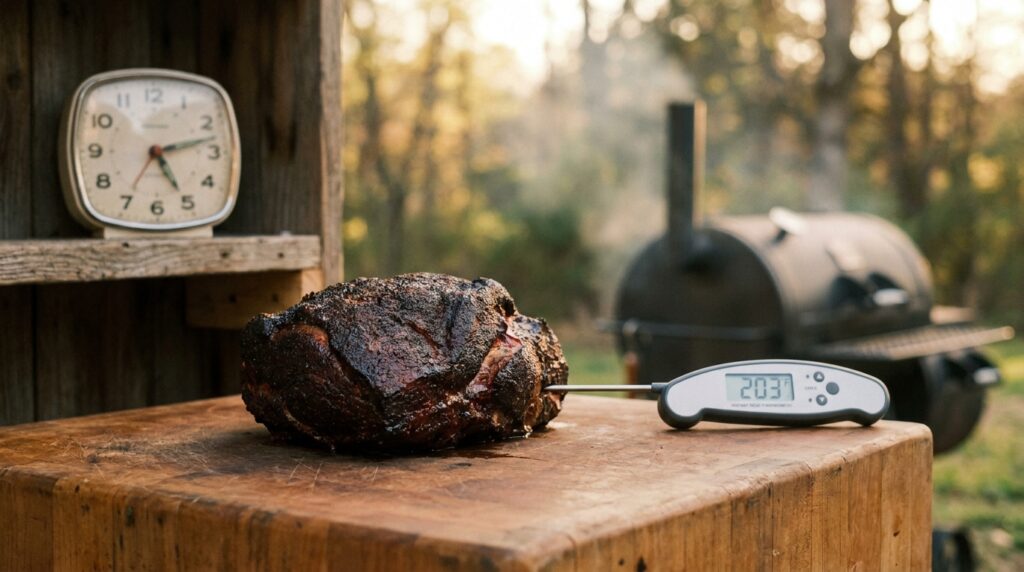
On Time, Every Time.
Pork Shoulder Cooking Time Calculator: Plan Backward From Dinner
A pork shoulder cooking time calculator plans backward from dinner: you set your serving time, enter the post-trimmed weight of a single piece of meat, and the tool hands you the moment to trim, season, and light the fire. It gives you a start time, not a finish time. Treat the output as a planning window, then start probing internal temps at roughly 70% of the estimated cook time. Every shoulder is different, and as the old saying goes, “It’s done when it’s done.” The calculator’s real job is keeping your guests from sitting hungry on the couch at 10:30.
What the Calculator Actually Does
Most people search for a pork shoulder time calculator expecting a countdown clock. That is not how it works, and that misunderstanding is what ruins dinner. A standard roast calculator multiplies weight by minutes per pound and hands you a finish time, but the Meat Smoking Calculator runs in reverse: you tell it when you want to serve, and it tells you when to trim, season, and light the fire so the meat has room to finish and rest.
The estimates behind it are pulled from what 9 out of 10 BBQ books and guides suggest, plus friends, various websites, personal recommendations from competition pros like Harry Soo at Slap Yo’ Daddy, and years of the site owner’s own cooks. It is a consensus starting point, not a physics engine.
Enter the Right Weight (This Is Where Most Cooks Blow It)
The single most common input error is typing in the number printed on the store label. The calculator’s meat weight is based on a single post-trimmed piece, not the purchase weight with fat you might trim off, and not the total contents of the cooker.
So trim your shoulder first, weigh it, then enter that number. If you are running two butts side by side, you do not add them together. A pork shoulder cooks by its own thickness and geometry, not by how much meat is crowding the grates around it. If you are stacking a cook with other proteins, read up on cooking multiple meats on one smoker before you start guessing at timing.
The 70% Rule
Start checking internal temperatures regularly once you hit about 70% of the calculator’s suggested cook time – that is the single most useful habit for landing pulled pork on schedule. That window is where the stall shows up, where a shoulder either surges ahead or parks for hours, and where you still have time to adjust: wrap it, bump the pit, or start planning a longer rest.
Check early and you learn nothing. Check late and you have already lost the ability to steer the cook.
Why Two Identical Shoulders Finish Hours Apart
All meat cooking times are unpredictable. Geometry, fat and muscle composition, moisture content, and even general humidity all move the needle. Two nine-pound butts from the same case can finish an hour or more apart, and that is normal, not a failure of your pit or your probe.
Larger pieces over 13 pounds get even trickier and may or may not cook within the suggested range at all. If you bought a monster, build in a bigger buffer and plan on a long, forgiving hold rather than a tight serving window.
Pair the Calculator With a Method
Timing is only half the cook. Once you have your start time, follow a method you trust from prep through rest. The Meat Church-inspired pulled pork walkthrough and the Mad Scientist BBQ pork butt approach both pair cleanly with a calculator-planned schedule. Pick one, run it, and let the tool handle the clock.
Send Your Numbers Back
This tool is openly a work in progress, and it improves on community cook data. If you finish a shoulder, share the details: meat type, weight, average pit temp, finish temp, and actual cook time. Those numbers get used to dial the estimates in tighter for everyone. You can read more about the guy behind it on the About John Kirker page.
FAQ
How accurate is a pork shoulder cooking time calculator?
Accurate enough to plan around, never exact. The estimates come from widely published BBQ guidance, competition pros, and personal cook experience, but every piece of meat is unique. Because geometry, fat content, moisture, and humidity all vary, no tool can be absolutely accurate. Use it to set a start time and a buffer, then let the thermometer make the final call.
Do I use the weight before or after trimming?
After trimming. The calculator is built around post-trimmed weight of a single piece, not the purchase weight that includes fat you plan to cut away. Enter the label weight and your estimate will run long.
Do I add the weight of two pork butts together?
No. The calculation is not based on the entire contents placed in the cooker. Enter the weight of one post-trimmed piece. Two eight-pound butts are still an eight-pound estimate, though a crowded pit and multiple pieces can shift real-world timing.
When should I start temping my pork shoulder?
Start checking internal temps regularly at around 70% of the suggested cook time. That gives you enough runway to react to a long stall or an unusually fast finish before your serving time is at risk.
What if my pork shoulder is over 13 pounds?
Expect more variance. Pieces over 13 pounds are trickier and may or may not cook within the suggested range. Give yourself extra hours on the front end and plan for a longer rest rather than a tight, minute-perfect serve.
Where do I run the calculator?
Head to the meat smoking calculator, set your serving time, and let it plan the cook backward from there.
Pork Shoulder Time Reference Table
Use this as a planning grid, not a promise. Find your post-trimmed weight for a single piece, cross it against your pit temp, and you have a rough total cook window to build your schedule around. Then start probing internal temps at roughly 70% of that estimate, because every shoulder is different.
| Post-trimmed weight (single piece) | 225F pit | 250F pit | 275F pit |
|---|---|---|---|
| 6 lb | 9 to 12 hrs | 7.5 to 10 hrs | 6 to 8 hrs |
| 8 lb | 12 to 16 hrs | 10 to 13 hrs | 8 to 11 hrs |
| 10 lb | 15 to 20 hrs | 12.5 to 16.5 hrs | 10 to 13.5 hrs |
| 12 lb | 18 to 24 hrs | 15 to 20 hrs | 12 to 16 hrs |
Target pull temp: 203F internal in the thickest part of the shoulder, with the probe sliding in like warm butter. Temperature alone is a guide; probe feel is the real tell.
Minimum rest: 1 hour before pulling, and 2 or more hours held in a faux cambro or warm cooler is better. A longer rest is your best insurance when the cook finishes early.
These ranges are wide on purpose. Geometry, fat and muscle composition, moisture content, and humidity all move the needle, and two identical butts can finish an hour or more apart. Pieces over 13 pounds may not land in these ranges at all, so build in a bigger buffer. When you want the actual clock times instead of a range, set your serving time in the Meat Church-inspired pulled pork cook and let it plan the cook backward for you.
Written by John Kirker, who built the first meat smoking calculator in 2011. Times come from cooks we have actually run and logged; temperature and feel decide the finish, never the clock alone.
Reviewed by John Kirker, Founder, John Kirker Inc. - last updated September 9, 2026.
Sources for this article
- Calculator schedules a cook backward from a set serving time (repeated across pulled pork and other cook posts)
- Meat weight is based on a single post-trimmed piece, not purchase weight with fat you might trim, and not the entire contents of the cooker
- Recommendation to check internal temps regularly starting around 70% of the suggested cook time
- All meat cooking times are unpredictable; 'It's done when it's done.'
- Pieces over 13 pounds can be trickier and may or may not finish within the suggested range
- Estimates are drawn from BBQ books/guides, friends, competition pros like Harry Soo of Slap Yo' Daddy, various websites, and John Kirker's own cooking experience
- Tool is a work in progress and community cook data (meat type, weight, avg pit temp, finish temp, actual time) improves it
- Variation comes from geometry, fat and muscle composition, moisture content, and humidity
Facts drawn from this site's own documented knowledge and first-hand experience.

Rated 5by 500+ users
Tagline
Other Options
The MeatSmokingCalculator will help you plan the timeline for any meal.
Planning, ingredients, preparation, and timing are the most critical elements to making and serving great food.
Having enough time is the most important part when it comes to slow and low!
Meat Smoking Calculator takes the thinking out of the process.
It makes cooking and serving amazing tasting smoked meats every time, on time.
SOME OF OUR FAVORITE SITES
Smoking a Turkey for Thanksgiving!
BBQ Brethren
Smoking Meat Forums
Deejay’s Smoke Pit
USDA’s Food Safety Guidelines
Smoking Pit
Virtual Weber Bullet
Smoking Times and Temps
* To help support this free site, posts contain affiliate links. If you use one of the affiliate links, we may earn a commission at no additional cost to you. As an Amazon Associate I earn from qualifying purchases.