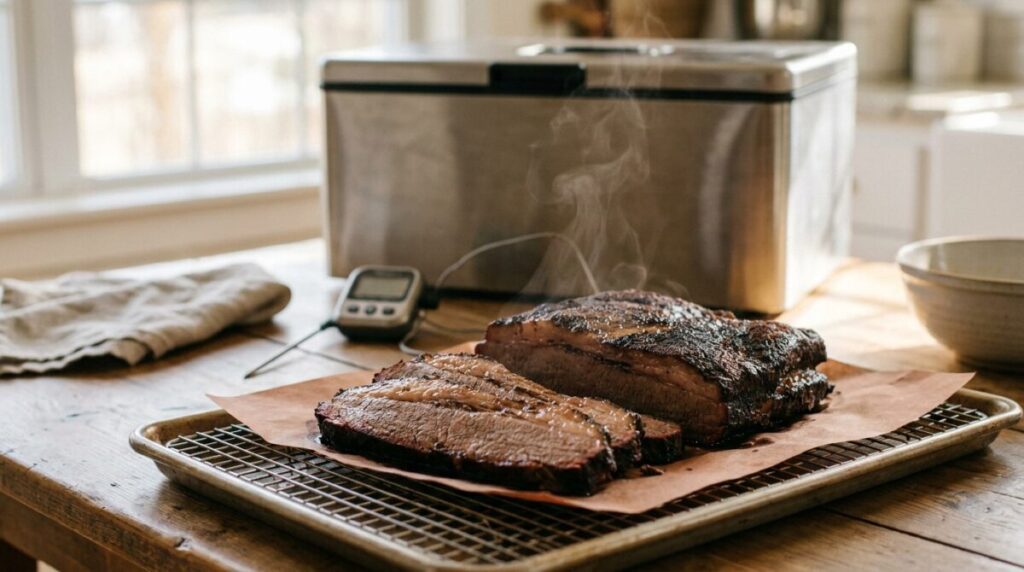
On Time, Every Time.
Collagen Breakdown in Meat Over Time: Why the Hold Does the Work
Collagen breaks down over time, not at a magic number, which is why the hold does the work. Heat plus moisture unwinds connective tissue into gelatin at a rate, and that rate keeps running long after the meat leaves the pit. Pull a brisket around 195F and hold it at 150F for hours and it converts collagen the entire time, finishing juicier and more tender than one pushed to 203F and sliced after a short rest. The hold is not storage. It is the second half of the cook. Below: what the chemistry lets us say, which cuts pay you back for hours and which punish you, and a scheduler that plans smoke, wrap, and hold backward from your slice time.
- Tenderness is temperature multiplied by time, not a probe number you hit and stop.
- The method here pulls brisket underdone near 195F, then holds long at 150F.
- 150F sits above the 140F hot-holding floor, so the meat is safe while collagen keeps working.
- High-collagen cuts gain from hours – brisket and pork butt take 4 to 12 at 150F, chuck 3 to 5. Lean cuts like prime rib hold under 2 and only lose.
- Plan the hold backward from the slice, never forward from the fire.
How does collagen break down in meat over time?
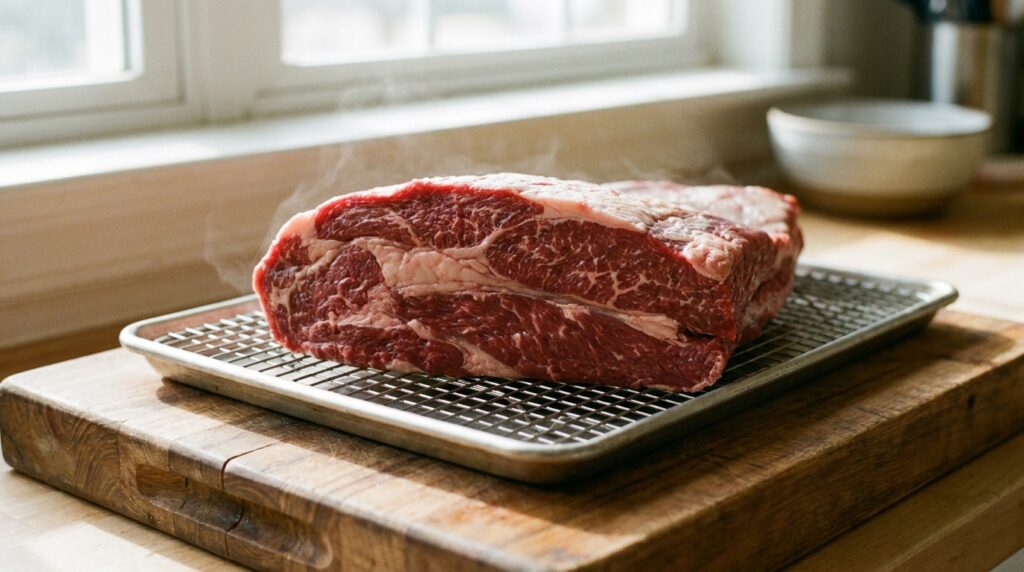
Collagen is the connective tissue that makes a brisket flat chew like a belt and a chuck roast fight your fork. Heat plus moisture unwinds it into gelatin, and gelatin is what makes a slice read as juicy even after the muscle has given up a lot of water.
Here is the belief worth correcting. Most people treat 203F as a switch, as if collagen flips on at a number. It does not. You can arrive at the same texture from a lower internal temperature by spending far longer there. That is the entire logic of a long hot hold.
Plain definitions, once
- Collagen conversion: connective tissue turning into gelatin under heat and moisture, over hours.
- Hold time: the stretch after the cook where the meat sits at a controlled temperature instead of being sliced.
- Hot hold: holding at or above 140F so the meat stays out of the danger zone.
- Underdone pull: taking the meat off the pit a few degrees short of your usual finish number on purpose, because the hold will finish it.
The rate question: what the chemistry lets us say
Collagen conversion behaves like a rate, and rates respond to both heat and duration. What that means in practice: the difference between a 195F pull with a long hold and a 203F pull with a short rest is not that one cooked the collagen and the other did not. Both converted collagen. They just spent their budget differently, one in hours at low heat, one in minutes at high heat while the muscle fibers squeezed.
Three things the meat-science literature does let us pin down. Collagen fibers begin to denature and shrink at roughly 140F (about 60C), which is the contraction that squeezes water out of the surrounding fibers (Tornberg, Meat Science 70:493-508, 2005, “Effects of heat on meat proteins”). Meaningful solubilization into gelatin needs more than that onset: conversion becomes appreciable above roughly 160F (about 70C) and climbs with continued heating (Bailey and Light, Connective Tissue in Meat and Meat Products, Elsevier, 1989). And the rate obeys the usual Q10-style behavior of protein reactions, roughly doubling for every 10C rise in temperature, which is why hours at a low hold temperature can substitute for minutes at a high one (Davey and Gilbert, Journal of Food Science 39:1149-1155, 1974, on the kinetics of cooking-induced connective tissue changes).
Here is where the evidence genuinely stops, said once so we do not have to keep saying it. Those figures come from controlled lab heating of isolated muscle and connective tissue, not from a brisket in a pit with a bark, a fat cap, and a wrap. Nobody has published rate constants for a whole packer held at 150F, so we will not pretend to a schedule accurate to the hour. Treat the numbers above as the direction the chemistry runs, and treat the tested outcome as the thing to plan on: pull near 195F, hold at 150F, get a juicier and more tender brisket than the high-finish, short-rest version.
The long hot hold is not a modern hack. It is the same play the legendary Texas joints run to serve perfect brisket hours after it leaves the pit: cook overnight, hold, slice to order.
Hours at a low hold can stand in for one hour at 203°F. Hold time that does the same collagen work as an hour at 203°F, if the conversion rate doubles every 10°C (18°F).
The doubling rule is the lab-measured direction of the chemistry (Davey and Gilbert, 1974), not rate constants for a whole brisket, so read the bars as the shape of the trade, not a timer. Below about 140°F the fibers only begin to shrink and conversion is slow; hold at 140°F or above for safety.
Where the method comes from
Steve Gow of Smoke Trails BBQ dug into how collagen renders to answer one narrow question: how do you hold a brisket after the cook so it comes out juicier and more tender rather than dried out? His answer flips the usual rule – pull a few degrees underdone, around 195F, then finish with a long, low hot hold at 150F.
Our full write-up of that cook is Smoked Brisket with a Long Hot Hold. The same logic is the spine of every schedule in our BBQ catering guides, because a caterer’s whole day depends on meat that keeps improving while it waits rather than degrading on a warmer.
Why pulling at 195F can beat pushing to 203F
195F long hold vs 203F short rest
Push hard to a high finish temperature and you buy collagen conversion with muscle-fiber squeeze. The fibers contract and force moisture out late in the cook, right when you have no time left to recover it. Pull earlier and hand the job to hours at 150F, and you get conversion without that final expulsion.
Pulled at 195F and held long at 150F, a brisket keeps converting collagen while it rests – the hold is a second cooking stage, not a parking spot.
The tradeoff is honest: a short rest gives you no conversion budget at all, so a short-rest cook genuinely does need the higher probe number. Pick one plan and commit to it. Splitting the difference gives you the worst of both.
Which cuts respond to a long hold, and which do not
Should this cut get a long hot hold?
Collagen-heavy cuts gain from time. Lean and delicate cuts only lose, because there is little connective tissue left to convert and every extra hour is just drying.
High collagen, rewards hours
Brisket, pork butt, beef shank. Long holds are the point. Boston Butt Smoking Time shows how the hours stack on pork.
Moderate collagen, some patience pays
Chuck, ribs, tri-tip cooked like brisket. Enough connective tissue that texture improves, but the useful window is shorter.
Low collagen, hold only for safety
Prime rib, tomahawk, poultry, fish. Hold to keep it safe and warm, never to improve it. Quality falls with every extra hour.
Hold windows: safety clock versus quality clock
These are two different clocks and confusing them is how people ruin good meat. Safety says above 140F you can hold as long as you like. Quality says every cut has a window before texture suffers, and that window is what “over time” actually means in hours:
- Brisket (whole packer): roughly 4 to 12 hours at 150F. The long end is where the method earns its reputation, and why the underdone pull near 195F matters.
- Pork butt: similar to brisket, comfortably in the same 4 to 12 hour band. Collagen-heavy and forgiving.
- Chuck, beef shank, brisket-style tri-tip: roughly 3 to 5 hours. Enough connective tissue that texture improves, but a smaller cut dries sooner.
- Ribs: a couple of hours at most before the meat goes past tender and starts to mush off the bone.
- Prime rib, tomahawk, poultry, fish: under 2 hours, and only for safety and warmth. There is little collagen left to convert, so every extra hour is purely loss.
Past those windows the texture goes soft and pasty rather than tender. These are indicative windows, not guarantees. A cabinet that cycles, a cooler that leaks heat, or a different starting internal temperature all move them, so probe rather than trust the clock. For the delivery-drive version of this table, including the warnings that fire when a drive is too long for a menu, see Holding and Transporting Smoked Meat.
Safety while the collagen works
A hot hold only counts if it stays hot. USDA guidance for holding cooked meat is 140F or above. A 150F hold sits clear of that floor with margin for a lid opening or a cabinet that cycles, which is why the method targets 150F rather than hugging the line, and it stays low enough to keep converting collagen instead of squeezing moisture out.
If you are deciding what to set a holding cabinet or oven to, we compared the two targets directly in 140F vs 150F Hold. Treat every hold estimate as an estimate. Verify with a probe, not with a timer alone.
Frequently asked questions
At what temperature does collagen turn to gelatin in meat?
There is no single flip point, which is the honest answer most charts dodge. Collagen starts denaturing and shrinking near 140F, but real solubilization into gelatin only becomes appreciable above roughly 160F. Past that, it is a rate, not a switch: conversion continues at hold temperatures as low as 150F, so more hours in the band means more gelatin. See the rate section above for what those lab figures can and cannot tell you about a whole packer.
How long should I hold a brisket at 150F?
Hours, not minutes. Plan on roughly 4 to 12 hours. Shorter than about 4 hours and you have not spent much of the conversion budget you gave up by pulling underdone. Your exact stretch depends on your slice time, which is what the scheduler below solves.
Does a longer hold make brisket dry?
That is exactly the fear this method was built to test, and the finding runs the other way: pulling underdone around 195F and holding low produces a juicier, more tender result than pushing the internal temperature high and slicing straight away.
Do I still need to rest a brisket if I hot hold it?
The hot hold replaces the rest. A long 150F hold does the job a cooler rest was trying to do, with real temperature control and no guessing about when the meat drifted below safe holding.
Credit and gear
This method comes from Steve Gow of Smoke Trails BBQ, who tested it against the collagen science – it is worth watching his full breakdown. You can find his rubs, classes, and more at smoketrailsbbq.com. Disclosure: some links may be affiliate links. This site is not affiliated with or endorsed by Smoke Trails BBQ; we credit the creator and link back so you can support their work directly.
Schedule the hold to the minute
Long-hold cooks fail one way: the pitmaster plans forward from lighting the fire instead of backward from the slice, then discovers at 4pm that the brisket needs three more hours. Set your serving time and let the tool plan the smoke, the wrap, and the hold backward for you.
For backward planning across other cuts, see the roast calculator guide.
Written by John Kirker, who built the first meat smoking calculator in 2011. Times come from cooks we have actually run and logged; temperature and feel decide the finish, never the clock alone.
Reviewed by John Kirker, Founder, John Kirker Inc. - last updated October 17, 2026.
Sources for this article
- Steve Gow of Smoke Trails BBQ studied collagen rendering to find how to hold brisket so it comes out juicier and more tender, not dried out
- The method pulls brisket a few degrees underdone, around 195F, then holds long and low at 150F
- Legendary Texas joints use the same long-hold trick to serve perfect brisket hours after the cook
- Safety says above 140F you can hold as long as you like; quality gives each cut a shorter window before texture suffers
- Credit, affiliate disclosure and non-affiliation statement for Smoke Trails BBQ taken verbatim from the source post
Facts drawn from this site's own documented knowledge and first-hand experience.

Rated 5by 500+ users
Tagline
Other Options
The MeatSmokingCalculator will help you plan the timeline for any meal.
Planning, ingredients, preparation, and timing are the most critical elements to making and serving great food.
Having enough time is the most important part when it comes to slow and low!
Meat Smoking Calculator takes the thinking out of the process.
It makes cooking and serving amazing tasting smoked meats every time, on time.
SOME OF OUR FAVORITE SITES
Smoking a Turkey for Thanksgiving!
BBQ Brethren
Smoking Meat Forums
Deejay’s Smoke Pit
USDA’s Food Safety Guidelines
Smoking Pit
Virtual Weber Bullet
Smoking Times and Temps
* To help support this free site, posts contain affiliate links. If you use one of the affiliate links, we may earn a commission at no additional cost to you. As an Amazon Associate I earn from qualifying purchases.