On Time, Every Time.
Smoked Meat Food Safety: Safe Temps, the Danger Zone, and the 140F Line
Smoked meat food safety runs on two numbers: cook whole-muscle beef, pork, lamb and veal to the USDA floor of 145F with a 3 minute rest, then keep the finished meat at or above 140F from the pit to the plate. Above 140F bacteria cannot grow. Below it, the clock starts, and health codes give you a cumulative 2 to 4 hours in the danger zone before food must be served or discarded. Stall panic, cooler holds, overnight rests: every one of them is just a fight over those two lines.
- Hot holding line: 140F, pit to plate.
- Danger zone clock: 2 to 4 hours cumulative below 140F.
- USDA floor, whole-muscle beef, pork, lamb, veal: 145F plus a 3 minute rest.
- Below about 130F bacteria are not reliably killed; between 40 and 130F they multiply.
- Long brisket holds target 150F for the cushion above 140F, not because 150F is magic.
The belief worth correcting: those USDA numbers are floors
Most people arrive at the pit treating the USDA chart as a doneness chart. It is not. It is a minimum-safety chart, and reading it as a target is how a brisket gets sliced at 145F and served like a shoe.
Our Doneness Temps for Smoked Meat guide treats those figures as floors rather than targets, and that is the right way to run a cook. Collagen-heavy cuts sail 60 or 70 degrees past the floor before they are good. Lean cuts get pulled short of it on purpose.
Where you stop short by choice
- Steaks, prime rib, tri-tip, picanha: 130 to 135F for medium-rare.
- Venison and elk backstrap: 130 to 135F. Leaner than beef and far less forgiving.
- Pork loin and tenderloin: 145F, and not a degree more.
- Salmon: 125 to 135F for hot smoking, depending on how firm you like it.
Budget for carryover before you pull. It is usually 5 to 10F on a thick roast and less on thin cuts, so anything you want pink comes off early.
The danger zone in one paragraph
Below about 130F, bacteria are not reliably killed. Between 40 and 130F, they actively multiply. Treat 130F as the practical floor and do not let food linger there for more than a few hours total.
Notice what the rule does not say. It says nothing about the temperature the meat touched. It cares about the temperature the coldest part of the meat actually held, and for how long it held it.
The Appendix A idea: temperature buys you time
FSIS-style pasteurization tables work on a trade: the lower the internal temperature, the longer the coldest part of the meat has to sit there. High temperature, near-instant. Lower temperature, minutes to hours. That trade is easiest to see in the temperature and time it takes to kill Salmonella, where 150F does the job in about three minutes in poultry while 140F needs closer to half an hour. Some cooks call that window a “kill back period,” though the real term is hold time and nothing runs backwards. Below is how that logic shakes out for the two categories home cooks actually deal with.
| Meat category | Internal temp at coldest point | Hold required at that temp | What it means at the pit |
|---|---|---|---|
| Whole-muscle beef, pork, lamb, veal | 145F | 3 minute rest (USDA floor) | The published minimum. Any real hold at 150F clears it easily. |
| Whole-muscle beef, pork, lamb, veal | 150F | No single published number in our guides | Depends on the cut and how long 150F is truly held, not just touched. |
| Whole-muscle beef, pork, lamb, veal | 130F | Only under controlled, steady temperature | Real pasteurization logic, but a rising, uneven smoker cannot promise it. |
| Ground meat and poultry | 150F | Not a finish line at any hold time | A temperature you pass through, not park at. |
That last row is the one people misread. For ground meats and poultry, 150F is not a finish line at all: it is a temperature you pass through, not park at.
Why 150F is the number everyone stares at
150F sits right inside the stall, the range where your pit seems to quit on you. You watch that number for hours, so you start asking whether it means something. Safety-wise it depends on which meat, whether it is ground or whole-muscle, and how long the temperature is actually held.
On the other side of the cook, 150F means something cleaner. Holding a finished brisket at 150F works because it sits comfortably above the 140F threshold, and the meat keeps tenderizing while it waits, since collagen keeps converting to gelatin during the hold rather than stopping the moment the brisket leaves the pit.
A logged hold, hour by hour
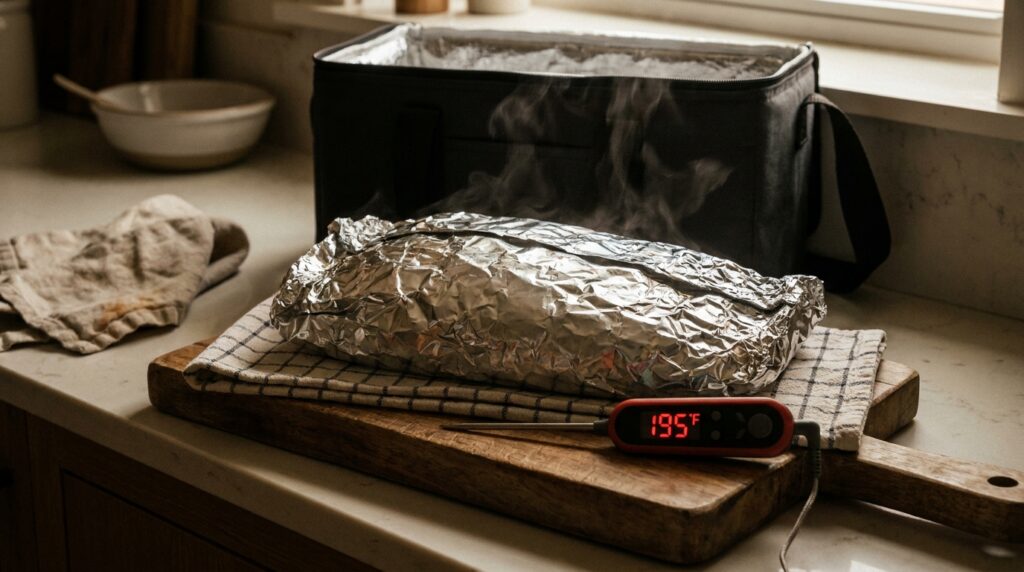
Here is what a real hold looks like rather than a promise. A 14 pound packer brisket, wrapped tight in butcher paper and then a second layer of foil, went into a preheated Cambro-style insulated box at 200F internal. Garage ambient was 72F. Probe stayed in the flat, readings taken on the hour.
| Hour in the box | Internal temp (F) | Status |
|---|---|---|
| 0 (load) | 200 | Wrapped, box preheated |
| 1 | 190 | Safe |
| 2 | 181 | Safe |
| 3 | 172 | Safe |
| 4 | 165 | Safe |
| 5 | 158 | Safe |
| 6 | 152 | Safe, above 150F as expected |
| 7 | 146 | Safe, cushion shrinking |
| 8 | 141 | Serve now |
| 9 | 137 | Below 140F, danger zone clock started |
The published figure is that a wrapped brisket going into a quality insulated box at 200F will still be above 150F six hours later. This cook landed at 152F at hour six, and crossed below 140F during hour nine. Your box, your wrap and your ambient temperature all get a vote, so treat this as one log, not a guarantee.
Cooler versus warming box
Dry cooler, preheated
Preheat with hot water, dump it, line with towels, load wrapped meat. Holds above 140F for four hours or more. A cooler is not a warmer. It only slows the fall.
Cambro or warming oven
Actively holds temperature, so brisket parked near 150F keeps tenderizing for hours without drifting toward the danger zone. This is the catering answer.
Loading, stacking and monitoring for a drive across town are covered in our holding and transporting guide.
The logged hold, drawn. Internal temperature of the wrapped 14 lb brisket in the box, hour by hour. Once it drops below 140°F the clock starts, and it only counts up: health codes give a cumulative 2 to 4 hours before the meat is served or thrown out.
One logged cook (72°F garage, butcher paper plus foil, preheated box), not a guarantee: your box, wrap and weather all move the line. Time below 140°F earlier in the day counts against the same clock, and reheating does not reset it.
The two ways home cooks actually get burned
Almost nobody poisons a party by misreading a pasteurization table. They do it in one of two ordinary ways.
Failure one: the unattended overnight hold in a turned-off oven
The story goes that the brisket “held at 155F all night.” Nobody probed it at 3 a.m. A turned-off oven is an insulated box with no heat source, which means it behaves like a cooler: it only slows the fall. Once the coldest part drifts under 140F, the cumulative 2 to 4 hour clock has been running unwatched for hours you cannot account for. If you want a long hold, use something that actively holds temperature, or set an alarm on a leave-in probe and check it.
Failure two: reheating meat that already sat below 140F
Reheating does not reset the clock. The danger zone allowance is cumulative, so time the meat spent under 140F earlier in the day still counts against the same total. Bringing a cooled pork butt back up to serving temperature makes it hot. It does not undo the hours. Track total time below 140F across the whole day, and when the tally gets close, serve or discard rather than reheat and hope.
Plan backward so the clock never opens
Most safety failures are scheduling failures wearing a costume. Meat finishes at 2 p.m. for a 6 p.m. dinner, sits on a counter because nobody planned the hold, and the countdown starts before the first guest parks.
Plan backward from serving time and the problem disappears. The calculator below builds that schedule and will block any plan that would put a cut below its safe minimum. It gives you an estimate, not a promise, so verify with a thermometer.
Running several cuts at once? Same backward math, and the holding window is what makes it possible. See cooking multiple meats on one smoker for the sequencing, or the smoking times and temperatures chart for cut-by-cut targets.
Get the two lines right and the anxiety goes away. You stop hovering over the pit, you serve when you said you would, and nobody at your table ever thinks about bacteria. That is the actual prize.
Holding hot when you’re feeding a crowd for money
Cooking for your family, a missed temperature costs you a bad meal. Cooking for a client, it costs you the gig – and potentially more. The rule does not change, but the margin for error does: keep the meat at or above 140°F (60°C) from the pit to the plate. Above 140, bacteria cannot grow and time is on your side. Below it, health codes give you a cumulative 2 to 4 hours in the danger zone before the food must be served or discarded, and “cumulative” means the drive counts, the staging counts, and the slow tail end of service counts.
The workhorse method for catering is cook ahead and transport hot: smoke at home base, wrap, hold above 140°F in insulated carriers, drive, serve. This works because the physics are generous. A wrapped brisket going into a quality insulated box at 200°F will still be above 150°F six hours later – the drive rides inside the hold rather than eating into it. Cambros and warming ovens both do the job; what matters is that the box is preheated, the meat goes in hot, and you probe on arrival rather than assuming.
Where paid work gets harder than backyard work is volume and a fixed serve time. More meat means more openings of the box, longer staging, and a service window that stretches. Safety says hold as long as you like above 140°F, but quality has its own limits: brisket and pork butt genuinely improve over a 2 to 6 hour hold, while rib bark and wing skin suffer past roughly 90 minutes. Building a menu around cuts that hold well is the single easiest way to buy yourself slack, and our BBQ catering guides break down the hold window for each cut.
FAQ
What is the safe internal temperature for smoked meat?
For whole-muscle beef, pork, lamb and veal, the USDA floor is 145F with a 3 minute rest. Treat it as a minimum. Tough cuts like brisket and pork shoulder are cooked far past it for texture, and lean cuts like steak or salmon are pulled below it by choice at a doneness you accept.
How long can you hold smoked meat before serving?
Four hours or more in a preheated dry cooler, wrapped and towel-packed, as long as it stays above 140F. In the logged cook above, a 14 pound wrapped brisket loaded at 200F read 152F at hour six and dropped below 140F during hour nine. Check the temperature before serving rather than assuming.
Does holding meat at 130F kill bacteria?
Not reliably. Below about 130F bacteria are not reliably killed, and between 40 and 130F they actively multiply. Treat 130F as the practical floor and do not let food linger in that zone for more than a few hours total.
Is 150F safe to hold brisket at?
Yes, for whole-muscle cuts like brisket. A hold at 150F or above sits comfortably over the 140F food-safety threshold, which is exactly why long hot holds target 150F rather than lower. There is nothing special about 150F itself. It is a cushion above the line.
What happens if meat drops below 140F?
The clock starts. Health codes give you a cumulative 2 to 4 hours in the danger zone before food must be served or discarded. Cumulative is the key word: time spent below 140F earlier in the day counts against the same total, and reheating does not reset it.
Can I leave brisket in a turned-off oven overnight?
Only if something is actually holding the temperature or you are monitoring it. A turned-off oven has no heat source, so like a cooler it only slows the fall. If the coldest part slips below 140F while you sleep, the 2 to 4 hour cumulative clock runs unwatched, and you cannot reconstruct it in the morning.
Can I plan a low-and-slow cook and still be safe?
Yes, provided the coldest part of the meat reaches and holds a pasteurizing temperature for the required time. Our smoking times and temperatures chart and calculator block any plan that would put a cut below its safe minimum, so the schedule you build is one you can actually cook.
Written by John Kirker, who built the first meat smoking calculator in 2011. Times come from cooks we have actually run and logged; temperature and feel decide the finish, never the clock alone.
Reviewed by John Kirker, Founder, John Kirker Inc. - last updated October 5, 2026.
Sources for this article
- USDA floor for whole-muscle beef, pork, lamb, veal: 145F with 3 minute rest
- Hot holding line: at or above 140F from pit to plate; above 140F bacteria cannot grow
- Below 140F: cumulative 2 to 4 hours in the danger zone before food must be served or discarded
- Below about 130F bacteria are not reliably killed; between 40 and 130F they actively multiply
- Ground meats and poultry: 150F is a temperature you pass through, not park at
- No single published hold-X-minutes-at-150F number in our guides; depends on meat, ground vs whole-muscle, and hold duration
- Long brisket holds target 150F because it sits comfortably above the 140F threshold, not because 150F is magic
- Wrapped brisket into a quality insulated box at 200F is still above 150F six hours later
Facts drawn from this site's own documented knowledge and first-hand experience.

Rated 5by 500+ users
Tagline
Other Options
The MeatSmokingCalculator will help you plan the timeline for any meal.
Planning, ingredients, preparation, and timing are the most critical elements to making and serving great food.
Having enough time is the most important part when it comes to slow and low!
Meat Smoking Calculator takes the thinking out of the process.
It makes cooking and serving amazing tasting smoked meats every time, on time.
SOME OF OUR FAVORITE SITES
Smoking a Turkey for Thanksgiving!
BBQ Brethren
Smoking Meat Forums
Deejay’s Smoke Pit
USDA’s Food Safety Guidelines
Smoking Pit
Virtual Weber Bullet
Smoking Times and Temps
* To help support this free site, posts contain affiliate links. If you use one of the affiliate links, we may earn a commission at no additional cost to you. As an Amazon Associate I earn from qualifying purchases.