On Time, Every Time.
Meat Church Brisket Recipe: The Schedule Behind the Rub
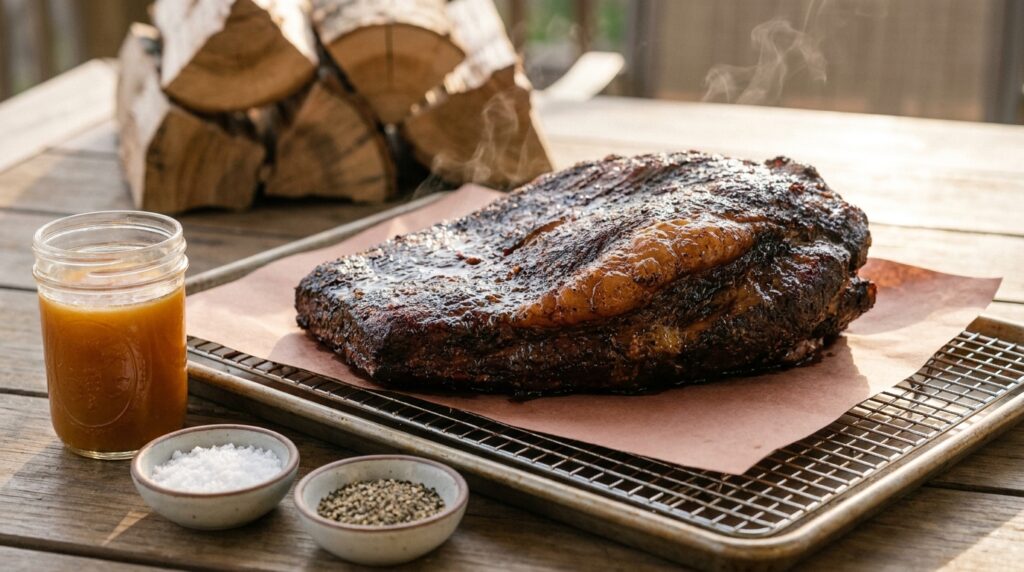
The Meat Church brisket method, stripped to its schedule: layer Meat Church Holy Cow over a base of Holy Gospel or plain SPG, smoke at 225F over oak until the bark does not smear when pressed (usually 165-180F internal), wrap in butcher paper, push to probe tender near 203F, then rest 1 hour minimum. Plan roughly 75 minutes per pound for sliced brisket. The rub you can swap for pennies. The trim, the wrap trigger and the pull temp decide whether dinner works.
- Rub: Holy Cow on top, Holy Gospel or SPG underneath, multiple passes on top, bottom, sides and edges
- Rub substitute: roughly 50/50 coarse kosher salt and 16-mesh black pepper
- Pit temp: 225F over oak or post oak, up to about 250F after the wrap
- Planning number: about 75 minutes per pound sliced, 82 minutes per pound pulled
- Wrap trigger: bark does not smear when pressed, usually 165-180F internal
- Finish: probe tender, generally near 203F; start probing at 195F
- Rest: 1 hour minimum, 2 to 4 hours in a dry cooler is better
The belief to drop before you start
Most people arrive believing the recipe lives in the shaker bottle. It does not. You can copy every Meat Church seasoning choice exactly and still pull a grey, tight flat out of the paper, and you can season with nothing but salt and pepper and cook the best brisket of your life.
The cost of getting brisket right is measured in trim, timing and patience, not in shaker bottles. That is why the schedule below gets more words than the seasoning.
What rub does Meat Church use on brisket?
The beef-forward top coat is Holy Cow, a coarse salt-and-pepper style rub, typically layered over a base of Holy Gospel or a plain SPG. Base layer first, beef rub on top, applied in multiple passes so top, bottom, sides and edges are all covered.
SPG means salt, pepper and granulated garlic. To skip the bottles entirely, use roughly equal parts coarse kosher salt and 16-mesh coarse black pepper, plus granulated garlic if you want the SPG profile. That 50/50 blend is the classic Texas-style rub and it builds excellent bark. The full substitution argument lives in Meat Church brisket rub vs salt and pepper.
16-mesh is a grind size, not a brand. It is the coarse, cracked-looking pepper that survives a long cook instead of dissolving into the bark. Fine table pepper at the same volume tastes harsher and vanishes.
What temperature does Meat Church cook brisket at?
This method runs 225F over oak, unwrapped, until the bark sets, then up to about 250F after the wrap. Some cooks run hotter, in the 250F to 300F range, and still get excellent results as long as the wrap and pull decisions are made by feel rather than by clock.
Internalize the split: pit temperature sets your finish time, bark feel and probe feel set your quality. The pull-early-and-hold variation is laid out in smoked brisket with a long hot hold, where the brisket comes off around 195F and holds at a steady 150F for up to 18 hours while the remaining collagen renders into gelatin. Hold time means the hours a cooked brisket sits at a stable serving temperature, not resting on a counter.
The trim, in weights and millimeters
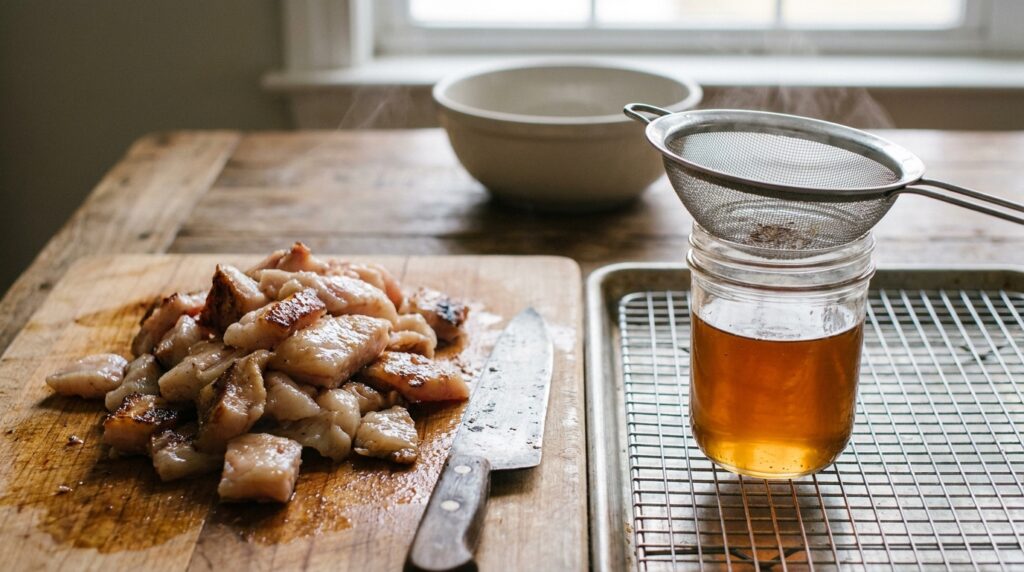
Trim the night before, not at 4 a.m. Fat cap down to about a quarter inch (roughly 6 mm), hard fat off both the point and flat, flat corners squared so they do not dry out, silver skin peeled off the underside of the flat.
On the 14 lb Prime packer I trimmed for the cook logged below, 2 lb 4 oz came off in fat and trim – the deckle seam, the hard lump on the point, the corner tabs. Slow-cooked over about five hours in a slow cooker and strained, that yielded a hair under 2 cups of liquid tallow, which is far more than the wrap needs. The surplus keeps in the fridge for the next cook.
Save every scrap of that hard fat. It goes back into the paper at the wrap, and it came off your own brisket, which is the cheapest moisture insurance in barbecue.
The cook, step by step
Brisket cook, trigger by trigger
- Season in multiple passes – bottom, top, sides, edges. Mustard or hot sauce as a binder is optional. Let it set at least 30 minutes, or overnight in the fridge.
- Smoke at 225F over oak or post oak. Expect roughly 6 to 8 hours before you are anywhere near the wrap.
- Spritz the exposed edges every few hours if they are drying out.
- Wrap when the bark does not smear under your finger, usually 165-180F internal, with some reserved tallow inside the paper.
- Return to the pit, up to about 250F if you want, and start probing at 195F. Pull at probe tender, generally near 203F. That last stretch typically runs about two more hours.
- Rest 1 hour minimum. 2 to 4 hours in a dry cooler is better.
Why the stall is not your grill failing
Somewhere around 150-170F the internal temperature parks itself, sometimes for hours. That is evaporative cooling, not a broken pit. Cranking the dial to “fix” it is how people blow past the bark-set window and wrap a wet, smeary brisket.
Two legitimate responses: ride it out at 225F, or wrap once the bark passes the smear test and let the paper beat it. Panicking is not a third option.
How long does a Meat Church style brisket take?
Use about 75 minutes per pound for sliced brisket and about 82 minutes per pound pulled, then add your rest on top. These are planning numbers, not guarantees – two 13 pound packers on the same pit can finish 90 minutes apart.
Worked example, 14 lb packer, serving 6 p.m. Saturday. 14 lb at 75 minutes per pound is 1,050 minutes, or 17.5 hours of cook. Trim Friday 8 p.m., season, fridge overnight. Fire the pit and hang the brisket at 2 a.m. Somewhere near 10 a.m. the bark should pass the smear test – wrap then, with tallow. Off the pit around 2 p.m. at probe tender. That leaves the brisket wrapped and resting from 2 p.m. to 5:30 p.m., inside the 2 to 4 hour dry-cooler window, with a half hour to slice before service.
Notice the buffer is deliberate. The rest is not dead time you squeeze – it is the shock absorber that lets a brisket finish 90 minutes early or 60 minutes late without anyone at the table knowing. Build the schedule backward from 6 p.m., not forward from the fire.
The smoking calculator takes brisket weight and your serving time and returns a start time, the wrap window and a scheduled rest it can stretch to hold the brisket until you serve.
One documented cook, including what went wrong
14.2 lb USDA Prime packer, offset stick burner, ambient 41F at lightoff and 58F by mid-afternoon, post oak splits. Grate thermometer held 225F to 240F. Probes were a ThermoWorks instant-read plus a leave-in grate probe, and the grate probe read 11F hot against the instant-read at the same spot, so every pit number below is the corrected one.
Fire at 2:10 a.m. Internal hit 152F at 8:40 a.m. and sat between 152F and 161F until 11:20 a.m., a stall of roughly two hours forty minutes. Bark passed the smear test at 11:30 a.m., 168F internal, wrapped in unlined butcher paper with about a third of a cup of its own tallow. Pit went to 250F. Started probing at 195F around 1:25 p.m.; the flat probed tender at 2:05 p.m., 12 hours from lightoff.
What went wrong: the hold. The brisket went into a cooler that had been sitting in a 41F garage and had not been preheated with hot water. Four hours later the flat was at 129F – under temperature, and past the point where a long hold is safe to serve from. It went into a 150F oven to recover, which worked for texture but cost the bark its crunch. Preheat the cooler. Verify the hold with a probe at the one hour mark, not at serving time.
Rub choice versus schedule choice: what actually moves the needle
| Decision | What it changes | Cost of getting it wrong | Fixable mid-cook? |
|---|---|---|---|
| Rub brand (Holy Cow vs 50/50 SPG) | Flavor profile of the bark | A seasoning you may prefer either way | No, but it barely matters |
| Trim (quarter inch cap, hard fat off) | Even cooking, clean slices, rendered tallow | Unrendered lumps, dried flat corners | No – it is done before fire |
| Wrap timing (smear test) | Bark integrity and moisture | Soft wet bark, or bark pushed too far | Yes, if you are watching |
| Pull temp (probe tender near 203F) | Tenderness | Tough at 195F, mushy well past 203F | Yes – keep probing |
| Rest (1 hour min, 2-4 hours better) | Juice retention | Brisket bleeds out on the board | No, once you cut it |
Three of those five rows cost nothing, and none of them are for sale.
Butcher paper or foil for the wrap?
Butcher paper vs foil
Unlined butcher paper breathes and preserves the bark you spent eight hours building. Foil is faster but softens it. Either is inside the method – just know which trade you are making, and wrap tightly with tallow either way.
Slicing so the work shows
Separate the flat from the point, because their grains run different directions. Slice the flat about pencil-thick against the grain – call it 6 to 7 mm, the width of a standard pencil – then turn the point and slice or cube it. Trim remaining hard fat as you carve.
USDA lists 145F as the safe minimum internal temperature for whole cuts of beef, with a rest. Brisket blows past that hours before it is tender, so at 203F the safety question answers itself. The temperatures that matter for brisket are the texture ones. If you want the same spine without the brand comparison, the brisket recipe for the smoker lays it out plainly.
FAQ
What temperature does Meat Church cook brisket at?
225F over oak, unwrapped, until the bark sets, then up to about 250F after the wrap. Cooks running 250F to 300F also get excellent results as long as the wrap and pull calls are made by feel.
What rub does Meat Church use on brisket?
Holy Cow, a coarse salt-and-pepper style beef rub, layered over a base of Holy Gospel or plain SPG. Base first, beef rub on top, multiple passes covering top, bottom, sides and edges.
What can I use instead of Meat Church brisket rub?
Roughly equal parts coarse kosher salt and 16-mesh coarse black pepper. Add granulated garlic for an SPG profile. The commercial rub is a flavor preference, not a requirement.
How long does a 14 lb brisket take to smoke?
About 75 minutes per pound sliced puts a 14 lb packer near 17.5 hours, plus rest. Treat it as a planning estimate, not a promise – finish time is set by probe feel, and the documented cook above ran 12 hours at a slightly hotter pit.
When should I wrap a brisket?
When the bark does not smear when you press it, usually 165-180F internal, and surface moisture has stopped pooling. Time and temperature are indicators; the smear test is the decision.
What temperature is brisket done?
Probe tender, generally near 203F. Start probing at 195F. If the probe still meets resistance at 203F, keep going – the number tells you when to start checking, not when to stop cooking.
How long should brisket rest?
One hour minimum, 2 to 4 hours in a dry cooler is better. Preheat the cooler with hot water first, and probe the brisket an hour in to confirm the hold is holding.
Written by John Kirker, who built the first meat smoking calculator in 2011. Times come from cooks we have actually run and logged; temperature and feel decide the finish, never the clock alone.
Reviewed by John Kirker, Founder, John Kirker Inc. - last updated October 17, 2026.
Sources for this article
- Layered rub: Holy Cow over Holy Gospel or SPG base, multiple passes top, bottom, sides, edges
- Pit temp 225F over oak, up to about 250F after wrap; 250F-300F also works if calls are made by feel
- Planning numbers: about 75 minutes per pound sliced, 82 minutes per pound pulled
- Wrap trigger: bark does not smear when pressed, usually 165-180F internal
- Finish: probe tender generally near 203F, start probing at 195F
- Rest: 1 hour minimum, 2 to 4 hours in a dry cooler is better
- Rub substitute: roughly 50/50 coarse kosher salt and 16-mesh black pepper, granulated garlic for SPG
- Trim: fat cap to about a quarter inch, hard fat off point and flat, square corners, peel silver skin
Facts drawn from this site's own documented knowledge and first-hand experience.

Rated 5by 500+ users
Tagline
Other Options
The MeatSmokingCalculator will help you plan the timeline for any meal.
Planning, ingredients, preparation, and timing are the most critical elements to making and serving great food.
Having enough time is the most important part when it comes to slow and low!
Meat Smoking Calculator takes the thinking out of the process.
It makes cooking and serving amazing tasting smoked meats every time, on time.
SOME OF OUR FAVORITE SITES
Smoking a Turkey for Thanksgiving!
BBQ Brethren
Smoking Meat Forums
Deejay’s Smoke Pit
USDA’s Food Safety Guidelines
Smoking Pit
Virtual Weber Bullet
Smoking Times and Temps
* To help support this free site, posts contain affiliate links. If you use one of the affiliate links, we may earn a commission at no additional cost to you. As an Amazon Associate I earn from qualifying purchases.