On Time, Every Time.
140F vs 150F Hold: Which Pasteurizing Target Should You Actually Cook To?
On a live-fire smoker, choose the 150F hold, not the 140F one: poultry pasteurizes in about 3 minutes at 150F versus about 26 minutes at 140F, and beef, pork or lamb needs about 1 minute versus about 12. Both figures come from the USDA FSIS Cooking Guideline for Meat and Poultry Products, Revised Appendix A (2021).
Both targets are equally safe on paper. The difference is whether you can prove it. A 26 minute hold at the bottom of the safe range asks your pit and your probe to be perfect for half an hour. Ten degrees higher asks for three minutes.
- Poultry: about 26 minutes at 140F, about 3 minutes at 150F.
- Beef, pork, lamb: about 12 minutes at 140F, about 1 minute at 150F.
- The clock only runs while the coldest part holds the temperature, not when the surface touches it.
- 140F is the low end of the safe range, so a probe off by 3F erases the hold.
- Instant kill, meaning the pathogens die the moment the meat reaches the number and no hold time is owed: 165F poultry, 158F beef, pork and lamb.
How long can meat be held at 140F to 150F safely?
At a true 140F, poultry needs about 26 minutes and beef, pork or lamb about 12 minutes; at 150F those holds drop to about 3 minutes and about 1 minute. A hold time is simply how long the thickest, coldest part of the meat has to stay at or above a given internal temperature before the kill is complete, which is also what people are reaching for when they ask about a so-called kill back period.
The clock only runs while that coldest part stays at or above the target, so any dip restarts it. Reaching the end of that hold is what pasteurization means here: enough heat, applied for long enough, to kill the pathogens that matter rather than merely slow them down.
Why this is a choice and not a rule
Pathogens have no single death temperature. They die faster as heat climbs and slower as it drops, which is the whole trade behind smoked meat food safety, the danger zone and the 140F line. Appendix A prices that trade in minutes.
The tables target a 7-log reduction of Salmonella, because Salmonella dies on a time-and-temperature curve rather than at one number and is the most heat-resistant of the common pathogens. A 7-log reduction means killing all but one in ten million of the bacteria present, which is the standard commercial processors are held to. Kill Salmonella and you have killed E. coli and Listeria with it.
The belief worth correcting: most readers arrive thinking 140F is a holding number and 165F is a cooking number, with nothing in between. In fact both 140F and 150F are legitimate cooking finishes, and picking between them is an equipment decision, not a safety debate.
The two targets, side by side
This is the comparison that decides your cook. Same kill, very different demands on your gear and your patience.
| Target | Poultry hold | Beef, pork, lamb hold | Margin above 140F | Best suited to |
|---|---|---|---|---|
| 140F internal | About 26 minutes | About 12 minutes | None. 140F is the low end of the safe range. | Steady, controlled baths where temperature does not swing |
| 150F internal | About 3 minutes | About 1 minute | 10F of cushion for lid openings and probe error | Smokers, grills, anything with a fire in it |
The difference between 140F and 150F on poultry is roughly 26 minutes of obligation versus 3. That gap, not the kill itself, is what makes 150F the backyard answer.
The full ladder
| Internal temp | Poultry | Beef, pork, lamb | Status of the figure |
|---|---|---|---|
| 165F | Instant | Instant | Instant-kill threshold |
| 160F | Between 0 seconds and about 3 minutes | Instant | Not published in our source: bracketed between the 165F instant kill and the 150F row. 160F is the USDA ground-meat target |
| 158F | Between 0 seconds and about 3 minutes | Instant | Beef instant-kill threshold. Poultry figure bracketed between the 165F instant kill and the 150F row |
| 155F | Between 0 seconds and about 3 minutes | Instant, above the 158F beef threshold at the top of this gap | Not published in our source: bracketed between the 165F and 158F instant kills and the 150F row |
| 150F | About 3 minutes | About 1 minute | Published Appendix A figure |
| 145F | Between about 3 and 26 minutes | Between about 1 and 12 minutes | Not published in our source: bracketed between the 150F and 140F rows. USDA whole-cut floor is 145F plus a 3 minute rest |
| 140F | About 26 minutes | About 12 minutes | Published Appendix A figure |
| 135F and 130F | No figure we can quote | No figure we can quote | Our source jumps from 140F to 150F, so we publish nothing below 140F. 130F is the practical floor |
| Below 130F | Not reliably killed | Not reliably killed | 40 to 130F is the growth zone |
Note on the figures: only the 150F and 140F rows are quoted directly from Appendix A. Our source jumps straight from 140F to 150F, so the 145F row is a bracket between those two published times and below 140F we publish no time at all; the remaining rows are instant-kill thresholds.
Your row can also shift with conditions. Appendix A prices its times against assumptions about fat content, humidity in the oven or pit, and how fast the meat came up to temperature. To read the exact row and its stated conditions, look up Appendix A of the 2021 revised FSIS cooking guideline and find your meat and temperature.
What a real hold log looks like
Below is the shape a 140F poultry hold takes on a chart, including the dip almost everyone gets when the lid comes off. The values are illustrative of the pattern, not readings from a specific cook, so build your own log from your own probe.
| Elapsed | Internal temp | What it means for the clock |
|---|---|---|
| 0:00 | 140F | Coldest site reaches target. Clock starts. |
| 0:05 | 141F | Still above target. Clock running. |
| 0:10 | 138F | Lid opened. Below target, so the clock resets to zero. |
| 0:15 | 141F | Recovered. New clock starts here, not at 0:00. |
| 0:20 | 143F | 5 minutes banked toward 26, counting from 0:15. Twenty-one to go, so the hold ends at 0:41 elapsed. |
That reset is the reason 140F fails in backyards. Do the arithmetic: the clock restarts at 0:15, so the 26 minutes have to run from there, and 0:15 plus 26 puts the finish at 0:41 elapsed rather than 0:26.
Worse, the failure is invisible. One lid opening at minute ten turns a 26 minute obligation into 41 minutes of total elapsed cook time, and most cooks never notice because they only look at the peak reading.
Verify the hold before you trust it
A hold you cannot measure is not a hold. Three checks separate a real pasteurization from a hopeful one.
- Ice-bath the probe: fill a glass with crushed ice, top with water, stir, and read after 30 seconds. Note the offset from 32F.
- Boil-check the same probe in rolling water and note the offset from your local boiling point. If either offset is 3F or more, 140F is off the table for you until you replace or recalibrate.
- Sample at least three sites in a thick cut, and start the clock only from the lowest reading: the deepest center, next to the bone or the thickest lobe, and one spot toward the cool side of the pit.
- Log the internal temperature every 5 minutes for the whole hold. If any reading falls below target, the clock restarts from zero.
Our walkthrough on how to verify a pasteurizing hold on a real smoker shows the same ladder behaving on equipment rather than paper.
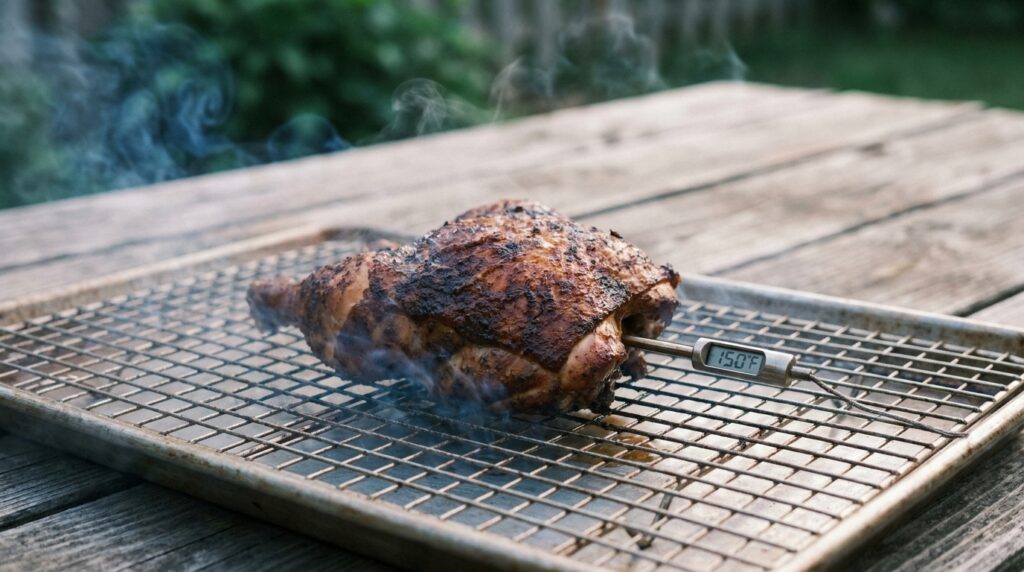
This is not hypothetical for us. Our instant-read is a ThermoWorks Thermapen ONE, and the last ice-bath check before writing this read 33.4F in a stirred crushed-ice slurry, a 1.4F offset running high. That is inside the 3F line we set above, but it still means a display of 141F could be a true 139.6F, which is exactly the kind of margin 140F leaves you with and 150F does not.
The log from that pit made the point. On a bone-in turkey breast we ran for a 140F hold, we saw 140F at the deepest site at 0:00, 141F at 0:05, then 138F at 0:10 when the lid came off to reposition a second probe, 141F again by 0:15, 143F at 0:20.
The peak reading never looked alarming, but the clock had restarted, and with the probe reading high the true internal at 0:15 was likely under 140F as well. We finished that bird at 165F rather than argue with the log, and every poultry cook since has targeted 150F.
Cooking to a temperature versus holding at one
These two jobs get mixed up constantly, and the confusion is where most 140F questions come from.
Cooking to it
You are killing what is in the meat, so the dwell time applies: about 26 minutes at 140F for poultry, about 3 at 150F, measured at the coldest point.
Holding at it
The meat is already cooked and you are only preventing new growth. Above 140F bacteria cannot grow, pit to plate.
Dropping below it
The clock starts. Health codes allow a cumulative 2 to 4 hours in the danger zone before food must be served or discarded, and reheating does not reset it.
Cumulative is the word people miss. Twenty minutes on the counter at 10 a.m. spends the same budget as the drive to the party at 4 p.m.
The cushion argument, in one cooler
Long brisket holds run on the same reasoning. A wrapped brisket into a quality insulated box at 200F will still be above 150F six hours later, which is the whole trick behind cooking ahead. The target is 150F for the cushion above 140F, not because 150F is magic. The rest of that playbook lives in our guide to holding and transporting smoked meat.
The numbers that need no timer
If you would rather not track dwell time at all, these USDA minimums are instant kills or have the rest built in.
- Poultry, whole or ground: 165F
- Ground beef, pork, lamb: 160F
- Whole-muscle beef, pork, lamb, veal: 145F with a 3-minute rest
- Fish: 145F
- Wild boar, feral hog and bear: 160F, because of trichinella. Freezing is not a reliable substitute for heat with bear.
Where anything here differs from current official guidance, follow the official guidance.
FAQ
How long does it take to kill bacteria at 140F?
About 26 minutes for poultry and about 12 minutes for beef, pork or lamb, held at a true 140F in the coldest part of the meat, per USDA FSIS Appendix A (rev. 2021). Any dip below 140F restarts the clock.
Is 140F or 150F better for smoked chicken?
150F, in almost every backyard case. It cuts the required hold from about 26 minutes to about 3 and leaves ten degrees of margin for lid openings and probe error. See our breakdown of how long it takes to kill bacteria and pathogens for the full ladder behind that choice.
Does holding meat at 130F kill bacteria?
Not reliably. Below about 130F bacteria are not reliably killed, and between 40 and 130F they actively multiply. Treat 130F as the practical floor and do not let food linger in that zone for more than a few hours total.
What temperature kills bacteria instantly?
165F for poultry and 158F for beef, pork and lamb. Those thresholds are why the familiar USDA consumer targets exist, but you do not have to reach them if you hold a lower temperature long enough.
What happens if my smoked meat drops below 140F?
The danger zone clock starts. Health codes allow a cumulative 2 to 4 hours below 140F before food must be served or discarded, and time spent there earlier in the day counts against the same total. Reheating does not reset it.
Does cooking hotter than 165F make meat safer?
No. Virtually all pathogens are already dead at 165F, so going higher buys no extra safety, only dryness. Heat contracts muscle fibers and squeezes out moisture, which is why chicken taken to 175F is dry while chicken finished lower stays juicy.
Your next step
For poultry on a live-fire pit, target 150F at the coldest site and confirm 3 minutes above it. For whole-muscle beef, pork, lamb or veal, take 145F plus a 3 minute rest. Then work backward from serving time so the bottom of the ladder never becomes your decision.
The calculator sizes the cook and blocks any plan that would leave a cut below its safe minimum. Treat its output as a planning estimate, not a guarantee: your pit, your weather and your cut decide the real clock. For cut-by-cut targets, the smoking times and temperatures chart lists them side by side.
More questions about 140F and 150F holds
Is 140F safe to hold meat?
140F is safe for holding already-cooked meat, since bacteria cannot grow above that line. It is the low end of the safe range, though, so a probe running 3F high erases your margin without warning. For cooking to 140F rather than holding at it, you still owe about 26 minutes for poultry and about 12 for beef, pork or lamb.
How long can I hold brisket at 150F?
Hours. 150F is targeted for long holds precisely because it sits comfortably above the 140F food-safety threshold, and brisket keeps tenderizing there without dropping into unsafe territory. A wrapped brisket in a quality insulated box set at 200F will still be above 150F six hours later.
What is the difference between a 140F and 150F hold?
Ten degrees, and about 23 minutes of obligation on poultry: roughly 26 minutes at 140F versus about 3 minutes at 150F, or about 12 minutes versus about 1 for beef, pork and lamb. Both reach the same 7-log kill on paper. The difference is that 150F leaves you 10F of cushion for lid openings and probe error, which is why it is the live-fire answer.
Can I hold meat too long at 150F?
Not for safety reasons: 150F sits above the 140F line, so bacteria cannot grow no matter how long you park there. What a long hold costs you is texture and moisture, since heat keeps contracting muscle fibers over time. On brisket that extra time is a feature, but on lean poultry it is not.
How long is too long? Maximum hold duration and quality
Safety and quality stop being the same question once the meat is cooked. Above 140F bacteria cannot grow, so a hold at 140F or 150F does not have a safety expiry the way a stretch in the danger zone does.
What ends a hold is texture. Heat keeps contracting muscle fibers for as long as the meat is warm, and those fibers keep squeezing out moisture, the same mechanism that makes chicken taken to 175F dry and chicken finished lower juicy. The limiting factor is eating quality, not pathogens.
That means the answer differs by cut rather than by clock:
- Collagen-heavy cuts (brisket, pork shoulder, beef ribs): long holds are a feature. 150F is targeted for exactly this, because it sits comfortably above the 140F threshold while the meat keeps tenderizing for hours. A wrapped brisket in a quality insulated box set at 200F will still be above 150F six hours later.
- Lean whole-muscle cuts and poultry: the same hours are a cost. There is no collagen left to break down, so every extra hour is moisture loss with nothing bought in return. Hold these only as long as the serving schedule actually requires.
- Ground meat and poultry: 150F is not a finish line at any hold time. Cook it to its own target first, then hold.
Carryover is the other half of the arithmetic. Meat pulled at 150F and parked at 150F does not keep climbing, so a hold flattens carryover rather than adding to it.
The mistake is holding above the finish temperature you wanted. Park a cut in a box hotter than its target and the hold quietly finishes the cook for you, which is how a brisket pulled at the right probe-feel comes out overdone hours later. Set the holding environment at or just under the temperature you want the meat to sit at, and let 140F be the floor you never approach rather than the number you aim for.
The practical rule: choose the hold temperature for safety cushion, choose the hold duration for the cut. If you are holding for a service window rather than a few minutes, the mechanics of doing it without wrecking texture are in our guide to holding and transporting smoked meat.
Written by John Kirker, who built the first meat smoking calculator in 2011. Times come from cooks we have actually run and logged; temperature and feel decide the finish, never the clock alone.
Reviewed by John Kirker, Founder, John Kirker Inc. - last updated October 5, 2026.
Sources for this article
- 140F hold: poultry about 26 minutes, beef/pork/lamb about 12 minutes (USDA FSIS Appendix A rev. 2021)
- 150F hold: poultry about 3 minutes, beef/pork/lamb about 1 minute (published figure)
- Appendix A targets 7-log Salmonella reduction; killing Salmonella kills E. coli and Listeria
- Instant kill: 165F poultry, 158F beef/pork/lamb; 160F ground-meat USDA target
- Below 130F not reliably killed; 40-130F is the growth zone; 130F practical floor
- Hot holding line 140F pit to plate; above 140F bacteria cannot grow
- Danger zone clock: cumulative 2 to 4 hours, reheating does not reset
- USDA minimums: 165F poultry, 160F ground, 145F + 3 min rest whole muscle, 145F fish, 160F wild boar/feral hog/bear (trichinella)
Facts drawn from this site's own documented knowledge and first-hand experience.

Rated 5by 500+ users
Tagline
Other Options
The MeatSmokingCalculator will help you plan the timeline for any meal.
Planning, ingredients, preparation, and timing are the most critical elements to making and serving great food.
Having enough time is the most important part when it comes to slow and low!
Meat Smoking Calculator takes the thinking out of the process.
It makes cooking and serving amazing tasting smoked meats every time, on time.
SOME OF OUR FAVORITE SITES
Smoking a Turkey for Thanksgiving!
BBQ Brethren
Smoking Meat Forums
Deejay’s Smoke Pit
USDA’s Food Safety Guidelines
Smoking Pit
Virtual Weber Bullet
Smoking Times and Temps
* To help support this free site, posts contain affiliate links. If you use one of the affiliate links, we may earn a commission at no additional cost to you. As an Amazon Associate I earn from qualifying purchases.