On Time, Every Time.
Can You Smoke Ribs and Pork Shoulder at the Same Time? Yes – Stagger the Start Times
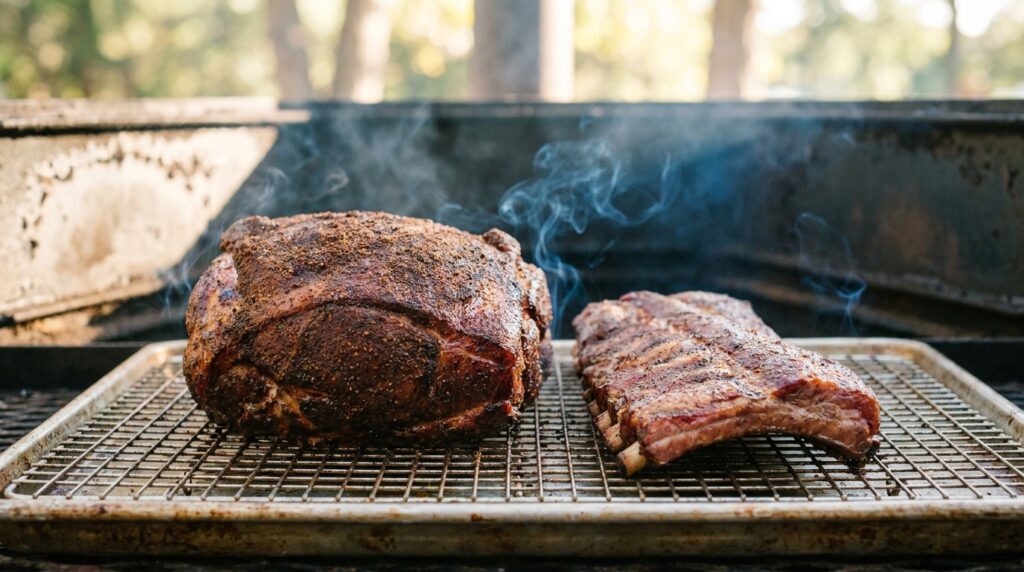
Yes, and the fix is start times, not a second smoker. Run one pit temp for both – 275F is the best single compromise – and put the pork butt on hours before the ribs. At 275F a butt runs roughly 1.25 hours per pound, so a 7 pounder lands near 9 hours and an 11 pounder near 14. Drop to 220F and the same butt stretches toward 1.5 to 1.75 hours per pound. Ribs need 5 to 6 hours, or 3-2-1. Count backward from dinner for each cut separately and let them overlap in the middle.
- Stagger, do not synchronise. Butt goes on the night before or very early, ribs mid-morning.
- One pit temperature for both. 275F suits pork butt and cooks it faster than 225F.
- Butt: 10 to 14 hours by weight (published). Ribs: 5 to 6 hours (published), or 3 open, 2 wrapped, 1 open.
- Whole-muscle pork is safe at 145F. Pulled pork keeps climbing to 180F-190F and probe tender.
- The butt is the cut that holds. Let it finish early on purpose.
Why “at the same time” is the wrong question
Most people arrive thinking these two cuts are somehow incompatible, as if the butt needs one environment and the ribs another. They do not. The pit holds one temperature and applies it to whatever is inside.
The real problem is arithmetic. One cut needs most of a day and one needs part of an afternoon. Load both racks at once and the ribs are drying out while the butt is still four hours from tender. Two cook lengths, two start times, one fire. That is the whole technique, and it is the same habit our guide to cooking multiple meats on one smoker argues for across any mix of cuts. For the butt itself – trim, rub, wrap, pull – work from the pork butt and pulled pork guide, then come back here for the two-cut clock.
What temperature do you run when smoking ribs and pork shoulder together?
Run 275F. It is the best single compromise for a mixed load: it suits brisket and pork butt, cooks them faster than 225F, and is hot enough not to ruin chicken skin if a bird joins later.
Plenty of pitmasters run pork lower. Our own butts-and-ribs writeup cooks pork at 220F and says openly it takes longer but is worth it. Both are legitimate. What is not legitimate is running two temperatures in one chamber and pretending you control either. Pick a number, write it down, and build both start times against it.
Hours per pound, and two example butts
Butt at 275F vs 220F
Pit temp is the assumption baked into every time estimate you read. Run hotter and the cook shortens, run cooler and it stretches. Here is what the published 10 to 14 hour range actually looks like once you attach a weight to it.
| Butt weight | At 275F | At 220F | Doneness | Source label |
|---|---|---|---|---|
| 7 lb butt | About 9 hours (7 x 1.25) | About 10.5 to 12 hours (7 x 1.5 to 1.75) | Probe tender, 180F-190F internal | Interpolated from published 10-14 hr range |
| 11 lb butt | About 14 hours (11 x 1.25) | Beyond the published range, plan a bigger buffer | Probe tender, 180F-190F internal | Interpolated from published 10-14 hr range |
| Spare or baby back ribs | 5 to 6 hours | 5 to 6 hours | Bend test | Published |
| Ribs, 3-2-1 | 3 open + 2 wrapped + 1 open = 6 hours | Same sequence | Bend test after the final hour firms them | Published |
Those per-pound rates are the published 10 to 14 hour window spread across ordinary butt weights, not a guarantee. Butts over 13 pounds get genuinely unpredictable and may not finish inside any suggested range at all. The smoking times and temperatures chart holds the per-cut pit temps and pull temps behind these numbers.
A worked 6:00 PM example, 9 lb butt at 275F
Two cuts, one pit: the backward schedule
A 9 pounder at roughly 1.25 hours per pound is about 11.25 hours, call it 11.5. Here is the arithmetic step by step, including the buffer, so you can swap your own weight in:
- Serve 6:00 PM. Target the butt off the pit by 2:00 PM, leaving a 4 hour hold window.
- 11.5 hours of cook back from 2:00 PM puts the butt on at 2:30 AM.
- Add a 3 hour buffer for the stall: butt on at 11:30 PM instead. Early is free, late is not.
- Smoker to temp takes about 30 minutes, so fire lit around 11:00 PM.
- Ribs at 6 hours (3-2-1) back from 5:30 PM: on the pit at 11:30 AM, wrapped at 2:30 PM, unwrapped 4:30 PM.
- Every lid opening restarts the recovery clock. If you open the pit to load ribs and the grate drops 40F, that recovery time comes out of your buffer, not out of thin air.
The two cooks overlap from 11:30 AM to 2:00 PM. That overlap is the point. Nothing gets rushed at the end, because the end is where you have no room left.
Enter the cut, the trimmed weight and the time you want to serve, and the pork shoulder cooking time calculator returns your start time plus step-by-step instructions. Switch it to Advanced to set rub and rest times yourself. Run it once for the butt, once for the ribs, and you have both start times on paper.
Rack position and airflow with two cuts on board
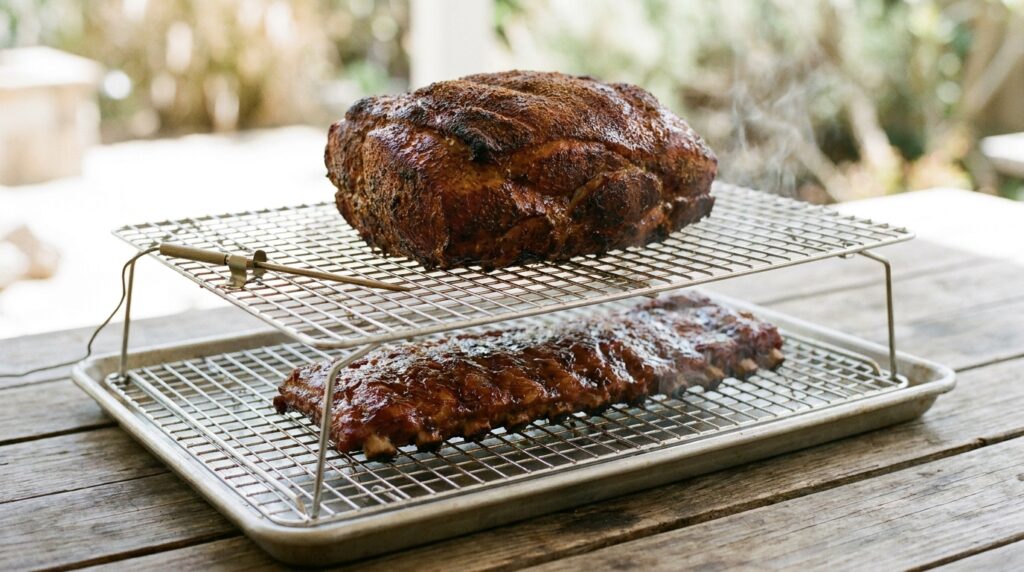
Give both cuts room. Airflow is why a crowded pit cooks unevenly, and a butt jammed against a rib rack ends up with a cold face and a hot face. If poultry ever joins this cook, it goes on the lowest rack so it cannot drip onto food that is already cooked.
Ribs are flat and forgiving of a hot spot. The butt is a dense block that punishes one. Put the butt where your pit runs steadiest and let the ribs take the compromise slot. If one side runs hot, rotate the ribs, not the butt.
The stall is why the butt, not the ribs, blows up your schedule
Two nine-pound butts from the same case can finish an hour or more apart, and that is normal, not a failure of your pit or your probe. Geometry, fat and muscle composition, moisture and humidity all move the needle. Ribs are thin and consistent, which is why they are the piece you slide.
Build the buffer into the butt and treat the ribs as the adjustable item, because a pork shoulder can sit stuck in the 180s for what feels like forever while a rack of ribs is done inside a 30 minute window you can see with a bend test.
Last winter I ran a 13 pound packer on an offset at 225F, ambient around 30F, steady wind across the firebox side. The chart said roughly 16 hours. It stalled at 158F for close to five hours and finished at 19 hours, three past plan. Nothing was wrong with the brisket, the wind was pulling heat off the cook chamber. That is why I now build a three hour buffer into every long cook and plan to hold, not hustle. The same lesson governs a butt sharing a pit with ribs: the long cut owns the risk, the short cut owns the flexibility.
Two smaller butts beat one big one
Past about 20 people, cooking two smaller cuts beats one enormous one. Cook time tracks thickness more than total pounds, so two smaller butts finish much sooner than one huge one of the same total weight, and you get a second chance if one runs long. It is why competition cooks so often run pairs. Our meat-per-person guide handles the quantity math; the scheduling logic is identical to what you are already doing with the ribs.
Safe temps and holding the butt while the ribs finish
Whole-muscle pork is safe at 145F internal by USDA. That is a safety number, not a doneness number. Pulled pork keeps climbing into the 180F to 190F range and on to probe tender, because that is where collagen breaks down. Ribs are judged by the bend test, not a thermometer reading.
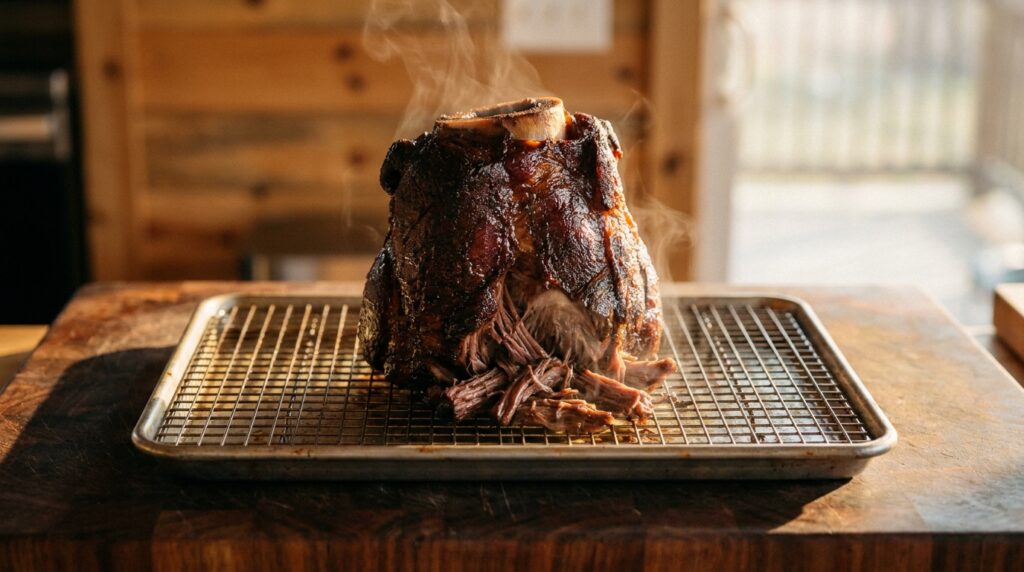
Holding means keeping cooked meat above the danger zone until you serve. The butt goes into an aluminum pan, covered with foil, into a cooler padded with towels, and it will ride a few hours before you pull it. That is the buffer that saves the day when the ribs need another 40 minutes.
How long can the pork butt wait while the ribs cook?
A wrapped butt in a towel-lined cooler holds for a few hours before pulling, far longer than any rib rack will make you wait. Plan for the butt to finish first on purpose. A butt that is early is a non-event. A butt that is late ruins dinner.
Wood and smoke on a two-cut cook
Be generous with wood for the first 3 to 4 hours, then coast on charcoal. Cherry or apple alongside hickory adds flavor and a little color. Because the butt starts hours ahead, the ribs get their own fresh smoke window when they go on. One more reason staggering beats loading everything at once.
Print this: the countdown checklist
Screenshot it. Times assume a 6:00 PM serve and a 9 lb butt at 275F; shift every line if your weight or pit temp differs.
- T-24h: rub on butt and ribs, foil-covered in the fridge.
- Morning of, before the butt goes on: second coating of brown sugar on both, back in the fridge.
- T-19h (11:00 PM): fire lit, smoker climbing to 275F. Butt out on the counter while it heats.
- T-18.5h (11:30 PM): butt on.
- T-6.5h (11:30 AM): ribs on, open.
- T-8h to T-9h into the butt: butt into a covered aluminum pan.
- T-3.5h (2:30 PM): ribs wrapped in foil.
- T-4h (2:00 PM): butt probe tender, off to the cooler in its pan, towels packed around it.
- T-1.5h (4:30 PM): ribs unwrapped, back on to firm up, sauce now if you want it.
- T-0.5h (5:30 PM): ribs off, bend test passed. Pull the butt.
- 6:00 PM: serve.
FAQ
Can you smoke ribs and pork butt at the same time on one smoker?
Yes. It is a normal mixed cook. Run one pit temperature for both, start the butt many hours before the ribs, and let the two cooks overlap in the middle. Nothing about these two cuts makes them incompatible on the same grate.
What temperature should I run for ribs and pork shoulder together?
275F is the best single compromise for a mixed load, and it cooks the butt faster than 225F. If you prefer low and slow, 220F for pork also works. It simply stretches the butt and pushes your start time earlier.
What goes on the smoker first, ribs or pork shoulder?
Longest cook first, so the pork shoulder. A butt runs 10 to 14 hours by weight and the ribs run 5 to 6, which means the butt goes on the night before or very early and the ribs join mid-morning.
How long does a 7 lb pork butt take compared with an 11 lb butt?
At 275F, roughly 1.25 hours per pound: about 9 hours for a 7 pounder and about 14 for an 11 pounder. At 220F the same butts stretch toward 1.5 to 1.75 hours per pound. Those are estimates spread from the published 10 to 14 hour range, not guarantees.
Will ribs dry out waiting for the pork butt to finish?
They will if you start them together, which is exactly why you do not. Time the ribs to finish just before you serve, and let the butt be the cut that finishes early and holds in a cooler.
Is 145F enough for pulled pork?
145F is the USDA safe internal temperature for whole-muscle pork, but it will not pull. Pulled pork needs to reach 180F to 190F and probe tender so the collagen breaks down. Cook to tenderness, not to the safety minimum.
Do I need to leave space between the pork butt and the ribs?
Yes. Leave room for airflow. A crowded chamber cooks unevenly and the dense butt suffers most from a blocked hot spot. If a bird is on the cook too, poultry goes on the lowest rack so it cannot drip onto cooked food.
Every time on this page is an estimate, not a guarantee. No two pieces of meat cook the same way. Start checking internal temps at about 70 percent of the suggested cook time, and remember the old line: it is done when it is done. Planning backward just means you have somewhere to put the extra hours when they show up.
Written by John Kirker, who built the first meat smoking calculator in 2011. Times come from cooks we have actually run and logged; temperature and feel decide the finish, never the clock alone.
Reviewed by John Kirker, Founder, John Kirker Inc. - last updated October 5, 2026.
Sources for this article
- 275F is the best single compromise pit temp for multiple meats; suits brisket and pork butt, faster than 225F, does not ruin chicken skin.
- Longest cook first; poultry always on the lowest rack so it cannot drip onto cooked food.
- Stagger, do not synchronise: pick serving time, count backward for each cut independently; overlap in the middle is fine.
- Butt smokes 10-14 hours depending on weight (Smoking Butts and Ribs).
- Ribs 5 to 6 hours; 3-2-1 method: 3 hours open, 2 wrapped in foil, 1 open to firm up.
- Rub applied about 24 hours ahead; second brown sugar coating the next morning; butt on counter ~30 min while smoker comes to temp.
- Butt into covered aluminum pan about 8-9 hours into the cook; cook to 180-190F internal; can stick in the 180s.
- Rest in a cooler padded with towels, still in pan covered with foil, a few hours before pulling.
Facts drawn from this site's own documented knowledge and first-hand experience.

Rated 5by 500+ users
Tagline
Other Options
The MeatSmokingCalculator will help you plan the timeline for any meal.
Planning, ingredients, preparation, and timing are the most critical elements to making and serving great food.
Having enough time is the most important part when it comes to slow and low!
Meat Smoking Calculator takes the thinking out of the process.
It makes cooking and serving amazing tasting smoked meats every time, on time.
SOME OF OUR FAVORITE SITES
Smoking a Turkey for Thanksgiving!
BBQ Brethren
Smoking Meat Forums
Deejay’s Smoke Pit
USDA’s Food Safety Guidelines
Smoking Pit
Virtual Weber Bullet
Smoking Times and Temps
* To help support this free site, posts contain affiliate links. If you use one of the affiliate links, we may earn a commission at no additional cost to you. As an Amazon Associate I earn from qualifying purchases.