On Time, Every Time.
What should I smoke for a Labor Day party?
Smoke one long cut overnight and one fast cut in the morning: pork butt on the night before, ribs or chicken leg quarters on Labor Day morning. That split is the menu. Price-wise, August 2026 USDA data puts pork butt at $2.35/lb (down 41.0% month-over-month), baby backs at $2.98/lb, spares at $2.78/lb and chicken leg quarters at $1.18/lb, while whole chicken sits at $6.41/lb and prime rib is up 20.7% to $15.41/lb. Past about 20 guests, run two smaller cuts instead of one enormous one.
- One long cut, one fast cut. Everything else is make-ahead and never touches the pit.
- Anchor: pork butt, the cheapest big-format smoke on the board this quarter.
- Volume: chicken leg quarters, not whole birds – the gap is more than five to one per pound.
- Skip prime rib unless you shop Southcentral, where it has been seen as low as $7.99/lb.
- Past 20 guests, two 10 pound cuts beat one 20 pounder for both speed and insurance.
- Kids count as half portions on smoked meat, full portions on hot dogs.
What should I smoke for a Labor Day party?
Pork butt the night before, ribs or chicken quarters the morning of. The long cut is done whenever it hits probe-tender and then holds; the fast cut finishes while people are arriving, so there is smoke in the air when the gate opens.
The belief most people arrive with is that a holiday menu needs one impressive centerpiece. It does not. A 20 pound brisket cooks unevenly and takes forever, and when it stalls for four hours with nothing else on the pit, that is not a slow cook, that is a crisis in front of thirty people.
Everything else on the table should be food that does not need heat from you: slaw, beans, cornbread, burgers and dogs on a separate grill. Our smoking times and temperatures chart holds the pit temp and pull temp for each cut, and the calculator below turns those into your start time.
The price table that should pick your meat this year
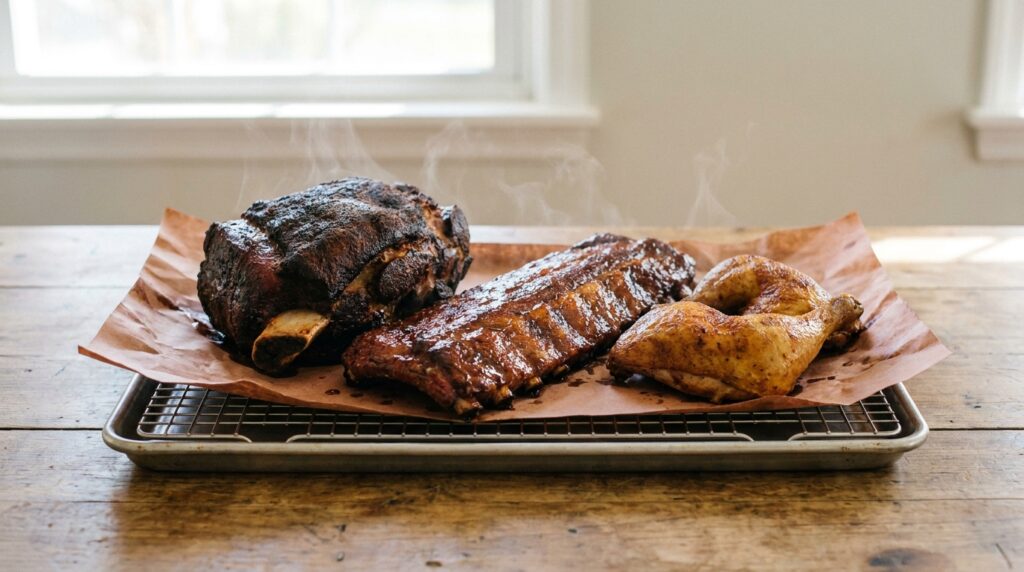
Recipe roundups tell you what tastes good in September. They do not tell you what a 30 person cook costs in September. Here is the August 2026 board, stated once – every later mention points back here. Figures come from the USDA retail feature pricing tracked in our August 2026 market report, which covers the August feature period and is where the month-over-month comparisons are drawn from.
| Cut | Price per lb | Month-over-month | Verdict |
|---|---|---|---|
| Pork butt | $2.35/lb | Down 41.0% | Holiday feature price, anchor meat |
| Baby back ribs | $2.98/lb | Down | Second meat |
| Spare ribs | $2.78/lb | Down | Second meat, more forgiving |
| Chicken leg quarters | $1.18/lb | – | Volume filler, one per guest |
| Whole chicken | $6.41/lb | Up | Buy parts instead |
| Prime rib | $15.41/lb | Up 20.7% | Not this holiday |
At $2.35 per pound, pork butt is the cheapest big-format smoke on the board this quarter, and chicken leg quarters at $1.18 per pound undercut whole birds at $6.41 per pound by more than five to one.
That 41.0% month-over-month drop on pork butt is not a typo: it is holiday feature pricing, the deep ad-week discounting stores run on grilling cuts heading into Labor Day, which is exactly why this is the month to stock the freezer.
The regional note worth acting on: chicken quarters have been running $0.99/lb in the Northeast, and prime rib as low as $7.99/lb in Southcentral. Full context is in this month’s market report.
The menu, by role on the table
Think in jobs, not recipes. Four roles, four dishes, and nothing on the list competes with anything else for pit space.
The anchor: pulled pork
Forgiving, holds for hours without insult, reheats clean. This is the meat that makes a backyard party feel catered, and this quarter it is also the cheapest.
The showpiece: ribs
Both cuts fell month-over-month in the August feature period, which makes a rib-heavy menu the smart substitute for brisket this year.
The volume play: chicken quarters
One quarter per person with beans, slaw and cornbread lands under $4 of meat cost per guest and nobody feels shorted.
The kid track: dogs and burgers
Add them to any menu when kids are coming. Count kids as half portions on the smoked meats and full portions on the dogs.
The 24 hour clock for a 30 guest, two meat cook
The 24 hour Labor Day cook clock
8:00pm Sun – trim and rubButts refrigerated uncovered10:00pm Sun – butts on at 250F16 hours booked to service4:00am Mon – wrap at bark setBark is the cue, not the clock9:00am Mon – ribs onShare pit with wrapped butts10:00am Mon – butts probe-tenderInto a dry cooler, 4 hours banked12:30pm Mon – quarters onGrate freed by the butts2:00pm Mon – serveRibs 5 hours in, quarters 90 minutes
This is the block most Labor Day articles skip. Pit at 250F, two 10 pound butts, three racks of spares, ten chicken quarters, serve at 2pm Monday.
| Clock | Action | Why here |
|---|---|---|
| 8:00pm Sun | Trim and rub both butts, refrigerate uncovered | Two hours of dry surface before the pit |
| 10:00pm Sun | Butts on at 250F | 16 hours booked to a 2pm service, not 12 |
| 4:00am Mon | Wrap when bark is set | 6 hours in, bark is the cue, not the clock |
| 9:00am Mon | Ribs on | Shares the pit with wrapped butts |
| 10:00am Mon | Butts probe-tender, into a dry cooler | 12 hours elapsed, 4 hours of hold banked |
| 12:30pm Mon | Chicken quarters on | Grate freed by the butts leaving |
| 2:00pm Mon | Serve | Ribs 5 hours in, quarters 90 minutes in |
Read the resets in that block. Butts on at 10:00pm and probe-tender at 10:00am is 12 hours elapsed against 16 hours scheduled, which leaves 4 hours of cooler hold as slack. If they stall instead and finish at 1:00pm, that is 15 hours elapsed and you still plate on time. That buffer is the entire reason the anchor goes on overnight. If pork butt is your centerpiece, schedule the 16 hours, not the 12.
It is 1:00pm, the butts are at 185F and guests are here
This is the failure the timeline implies and never names. Service is at 2:00pm, the anchor meat is an hour or two of collagen away from probe-tender, and the yard is already full. You do not wait it out. You run three moves at once, in this order.
- Serve the ribs first, right now. They went on at 9:00am and are four hours in. Slice and put them out as the opening course. Food on plates buys you the hour you need and nobody counts what is missing.
- Crank the pit to 300F with the butts wrapped. Wrapped meat past the stall is already through the evaporative plateau, so higher heat drives the last 20 degrees fast rather than drying the bark. Keep the probe in and stop cooking to the clock.
- Chop instead of pull. At 195F to 200F the meat will slice and chop cleanly even if it is not falling apart. Chopped pork on a bun with sauce reads as a finished dish. Shredding is what needs the extra hour, so cut the goal, not the quality.
- Move the chicken quarters up. If they are not on yet, they are 90 minutes and the fastest real protein you have left. If the pit is at 300F they run faster still.
- Skip the cooler hold. The four banked hours were the buffer and you have spent them. Straight off the pit, ten minutes to settle, then chop and serve.
What you do not do: unwrap to check the bark, pull below 190F and hope, or announce a delay. Poultry still goes to 165F and everything held for service stays above 140F, no matter how far behind you are.
Schedule this cook to the minute
Butts at 250F wrapped at bark set, ribs on five hours before service, quarters 90 minutes before. Put your own weights and service time in here:
Times from the calculator are estimates, not guarantees. A stall can add hours, which is exactly the risk the overnight start and the cooler hold are there to absorb. Our guide to planning a smoking schedule with a stall buffer works through why cooks run long.
Two smaller cuts beat one big one
Past about 20 people, cook two smaller cuts rather than one enormous one. Two 10 pound packers finish faster and more predictably than a single 20 pounder, and if one runs long you still have the other. Competition cooks run pork butts in pairs for exactly this reason.
Portion math, including the half-portion rule for kids, is worked out in full in our meat per person guide.
Capacity is the real limit, not appetite. Measure your grate in inches, multiply length by width, and budget footprint per piece: a 10 pound pork butt sits in roughly 8 by 8 inches, call it 64 square inches; a rack of spares laid flat takes about 6 by 16 inches, roughly 96 square inches, or about 50 square inches rolled or racked on edge; a chicken quarter takes about 5 by 7 inches, roughly 35 square inches. Add 15% so pieces are not touching, since meat that touches steams instead of taking smoke.
Run the numbers before you buy. A 22 inch kettle grate is about 380 square inches, so four butts, three racks flat, or ten quarters, and not two of those at once. A 24 by 18 inch cabinet shelf is 432 square inches per shelf, so a two-shelf cabinet clears roughly 860 square inches: two butts plus three flat racks plus a few quarters. A 100-guest two-meat job runs about 8 to 10 butts, or roughly 640 square inches of butts alone before the second meat, which is a 1,200 square inch offset or two staggered cooks. Measure the grate before you buy the meat.
Fast cuts if you are starting Monday morning
No overnight? Change the cut, not the ambition. Published windows from our cut guides:
- Shellfish: under 30 minutes at 225F. The appetizer that buys you an hour of goodwill.
- Fish fillets: 60 to 120 minutes, most pulling at 145F. Whole trout runs about 90 minutes, halibut about 75.
- Pork tenderloin: about 90 minutes at 225F, or about 1 hour at 300F if the crowd is early.
- Sausage links: 2 to 3 hours to 160F. The filler nobody complains about.
- Whole pork loin: 2 to 3 hours to 145F, the cheapest slicer on the table.
- Brisket, 12 pound packer: 15 to 18 hours at 225F, about 75 minutes per pound sliced and 82 per pound pulled. Not a morning-of cut.
Pork butt, ribs, whole chicken and beef short ribs vary by pit, so cook them to probe-tender. Our breakdown of which cut to smoke for the hours you actually have sorts every category by window.
Food safety on a hot holiday afternoon
Poultry gets cooked to a USDA safe internal temperature of 165F. Whole muscle pork and beef reach 145F with a 3 minute rest, ground meats 160F. Once cooked, food stays above 140F or goes below 40F.
Hold time means the stretch between meat coming off the pit and hitting a plate, and on Labor Day it always runs longer than planned. A fast digital thermometer plus a backup is the single most important tool in cookout food safety, and it matters more than any rub on the shelf.
Prep the day before
- Trim and rub the butts by 8:00pm so the surface dries before they hit the pit.
- Make slaw, beans and any macaroni or potato salad Sunday night.
- Count fuel for the full cook plus 25%, calculated from cook hours, not vibes.
- Stock butcher paper, heavy foil and nitrile gloves in bulk.
- Set out buns, sauces and serving pans so Monday you only touch meat.
FAQ
What is the best meat to smoke for a Labor Day party?
Pork butt for pulled pork. It is forgiving, it holds for hours in a cooler, and this quarter it is the cheapest big-format smoke available. Pair it with ribs or chicken leg quarters as the fast second meat.
How much meat per person for a Labor Day cookout?
It depends on the cut and the crowd, and our meat per person guide runs the numbers. The rule that trips people up: count kids as half portions on the smoked meats and full portions on hot dogs.
Should I smoke a brisket for Labor Day?
Only with 15 to 18 hours available for a 12 pound packer at 225F and something else on the pit as backup. Both rib cuts fell month-over-month in the August 2026 feature period, so a rib-heavy menu is the better play. Prime rib is up, so leave it for another holiday.
Is it cheaper to buy whole chickens or chicken quarters?
Quarters, by more than five to one per pound. See the price table above, and note the Northeast has shown quarters at $0.99/lb.
What can I smoke in under two hours for a party?
Shellfish in under 30 minutes at 225F, fish fillets in 60 to 120 minutes, whole trout about 90 minutes, halibut about 75 minutes, and pork tenderloin about 90 minutes at 225F or about 1 hour at 300F.
What time should I put the pork butt on for a 2pm party?
10:00pm the night before at 250F for two 10 pound butts, which books 16 hours against a 2pm service. Probe-tender usually lands around 10:00am, giving you four hours of cooler hold as buffer.
What temperature is safe for smoked meat at a cookout?
Poultry to 165F, whole muscle pork and beef to 145F with a 3 minute rest, ground meat to 160F. Hold cooked food above 140F or chill it below 40F.
If people start asking you to cook for them
A Labor Day party is the rehearsal for a paid one. The first-job classic is pulled pork plus sausage, two make-ahead sides, buns and sauce: forgiving meats, minimal day-of stress. Our catering menu ideas by event and budget lay out the versions that have actually sold.
- Generates instant, personalized step-by-step smoking plans scheduled backward from your target dinner time
- Dedicated calculators for turkey, brisket, pork butt, and ribs, plus a classic all-purpose calculator
- Plans account for the full cook: prep steps, the stall, the wrap, and the rest
- Community recipes and "My Pit" cook syncing let you save and compare real cooks
- States plainly that cook times are planning estimates and doneness should always be verified with a thermometer, with dedicated food safety guidance
Written by John Kirker, who built the first meat smoking calculator in 2011. Times come from cooks we have actually run and logged; temperature and feel decide the finish, never the clock alone.
Reviewed by John Kirker, Founder, John Kirker Inc. - last updated August 28, 2026.
Sources for this article
- Pork butt $2.35/lb, down 41.0% MoM, cheapest big-format smoke this quarter - State of the Smoke: August 2026
- Baby back ribs $2.98/lb and spare ribs $2.78/lb, both down double digits MoM - State of the Smoke: August 2026
- Whole chicken $6.41/lb vs chicken quarters $1.18/lb; Northeast quarters $0.99/lb - State of the Smoke: August 2026
- Prime rib up 20.7% MoM to $15.41/lb; Southcentral as low as $7.99/lb - State of the Smoke: August 2026
- Quarter chicken plate under $4 of meat cost per guest; kids count as half portions on smoked meats, full on dogs - BBQ Catering Menu Ideas
- Two smaller cuts beat one big one past ~20 people; 20 lb brisket cooks unevenly; competition cooks run pairs - How Much Meat Per Person
- Time windows: shellfish under 30 min at 225F; fish fillets 60-120 min; trout ~90 min; halibut ~75 min; pork tenderloin ~90 min at 225F or ~1 hr at 300F; sausage 2-3 hrs to 160F; po
- Capacity: 100-guest two-meat job needs 8-10 pork butts' worth of grate space; fuel plus 25%; fast digital thermometer plus backup is the most important food safety tool; butcher pa
Facts drawn from this site's own documented knowledge and first-hand experience.

Rated 5by 500+ users
Tagline
Other Options
The MeatSmokingCalculator will help you plan the timeline for any meal.
Planning, ingredients, preparation, and timing are the most critical elements to making and serving great food.
Having enough time is the most important part when it comes to slow and low!
Meat Smoking Calculator takes the thinking out of the process.
It makes cooking and serving amazing tasting smoked meats every time, on time.
SOME OF OUR FAVORITE SITES
Smoking a Turkey for Thanksgiving!
BBQ Brethren
Smoking Meat Forums
Deejay’s Smoke Pit
USDA’s Food Safety Guidelines
Smoking Pit
Virtual Weber Bullet
Smoking Times and Temps
* To help support this free site, posts contain affiliate links. If you use one of the affiliate links, we may earn a commission at no additional cost to you. As an Amazon Associate I earn from qualifying purchases.