On Time, Every Time.
Which Cut Should You Smoke? Match the Meat to the Hours You Actually Have
Match the cut to the hours you actually have, not to ambition. Under 2 hours: fish, shellfish or pork tenderloin. Two to three hours: sausage links to 160°F or a whole pork loin to 145°F. About three hours: a quartered rabbit at 250°F. All day: brisket at roughly 1.5 hours per pound at 225°F, so 15 to 18 hours for a 12 pound packer, pastrami at about 75 minutes per pound of smoke at 250°F, and a whole hog at about 9 minutes per pound of dressed weight. Pick the cut that fits the window and you stop losing dinners to the stall.
- Under 30 minutes: shellfish at 225°F.
- 1 to 2 hours: fish fillets (60 to 120 min), whole trout (~90 min), halibut (~75 min), pork tenderloin (~90 min at 225°F, ~1 hr at 300°F).
- 2 to 3 hours: sausage links to 160°F, whole pork loin to 145°F.
- About 3 hours: quartered rabbit at 250°F.
- All day: brisket at about 75 min per lb sliced, 82 min per lb pulled at 225°F; pastrami about 75 min per lb of smoke at 250°F; whole hog about 9 min per lb dressed.
- Pork butt, spare and baby back ribs, whole chicken, turkey and beef short ribs: times vary by pit and cut, so cook to probe-tender and use the linked cut guides.
The real question is not “how long,” it is “which cut fits today”
You are staring at a case of meat with a dinner time already promised to people. That is the actual problem. A time chart answers a question you cannot un-ask once the brisket is on the pit at 6 a.m. and still stalled at 3 p.m., which is why it helps to plan backward from your serving time instead of forward from the moment the meat hits the grate.
So flip it. Start from the hours you genuinely have, then pick the cut. Thickness matters far more than weight, which is why a thick fillet and a thin one of the same poundage can finish minutes apart, and why per-pound math only earns its keep on thick, collagen-heavy cuts.
If ribs are what you are really after, that is its own timing question with its own answers, and the hot and fast baby back ribs walkthrough is the page to work from rather than a generic chart.
Under two hours: the weeknight tier
This is seafood and lean pork. The window between perfect and chalky is measured in minutes, so the thermometer leads and the clock follows.
Shellfish
Usually 30 minutes or less at 225°F. Watch it, do not schedule it.
Fish fillets
60 to 120 minutes at 225°F depending on thickness. Halibut runs about 75 minutes to a 145°F pull.
Pork tenderloin
About 90 minutes at 225°F to a 145°F pull, or roughly an hour at 300°F.
A salmon fillet runs roughly an hour to ninety minutes at 225°F. Pull at 145°F, or around 125°F if you like it silky and trust your sushi-grade fish. It is done when it flakes and the white albumin just begins to show.
Whole trout takes about 90 minutes at 225°F; fillets come in around 60. The smoked seafood guide collects the fish and shellfish numbers in one place.
Two to four hours: the afternoon tier
Sausage links take roughly two to three hours at 225°F until they hit 160°F internal for fresh pork or beef. Go low and slow, because direct heat blows the casings out and renders the fat before the inside cooks.
A whole pork loin, not the smaller tenderloin, goes at 225 to 250°F to 145°F internal, usually 2 to 3 hours. It is lean, so a wet or dry brine the night before is the single best moisture move. Rest 10 minutes, slice across the grain.
A quartered rabbit runs about 3 hours at 250°F. Spare ribs, baby backs and whole chicken also live in this general band, as does a rack of lamb at roughly an hour, though lamb is a doneness meat rather than a collagen meat, so the probe ends that cook. For all of them the numbers move enough with trim and pit that you should cook by feel and temperature rather than a stopwatch.
All day: brisket, pastrami, hog, pork butt and beef short ribs
These are the cuts where per-pound planning works, and where you start earlier than feels reasonable.
| Cut | Pit temp | Time | Pull |
|---|---|---|---|
| Brisket, sliced | 225°F | About 75 min per lb | Probe tender |
| Brisket, pulled | 225°F | About 82 min per lb | Probe tender |
| Brisket | 250°F | 1 to 1.25 hr per lb | Probe tender |
| Pastrami | 250°F | About 75 min per lb of smoke | 165°F, then steam to about 200°F |
| Whole hog | 250°F | About 9 min per lb dressed | 195-205°F |
| Pork butt | Varies by pit | Plan backward, see calculator | Probe tender |
| Beef short ribs | Varies by pit | Varies with thickness | Probe tender |
| Spare and baby back ribs | Varies by pit | Varies, hot and fast is possible | Bend test |
| Whole chicken and turkey | Varies by pit | Varies with spatchcocking | Cook to temp, not clock |
A 12 pound packer at 225°F lands somewhere around 15 hours, and 15 to 18 is the honest range. Move to 250°F and you drop to roughly 1 to 1.25 hours per pound. The brisket method guide explains why the finish moves, and the sliced brisket timing page has the per-pound breakdown.
Pastrami is two stages: about 75 minutes per pound of smoke at 250°F to build crust and a smoke ring, pull around 165°F, then steam to about 200°F internal so it slices tender. From store-bought corned beef, soak it first to pull the excess salt.
A whole hog takes about 9 minutes per pound of dressed weight at 250°F: roughly 11 to 12 hours for a 75 pounder, 15 hours at 100 pounds, and up to 18 hours at 120. Pull when the hams and shoulders probe 195 to 205°F. The whole hog guide covers the logistics a chart cannot.
For pork butt specifically, the pork shoulder cooking time calculator is built to plan backward from dinner, which is exactly the habit this page is arguing for. It is also the backbone of a Labor Day party plan, where a butt goes on overnight and ribs or chicken leg quarters follow in the morning.
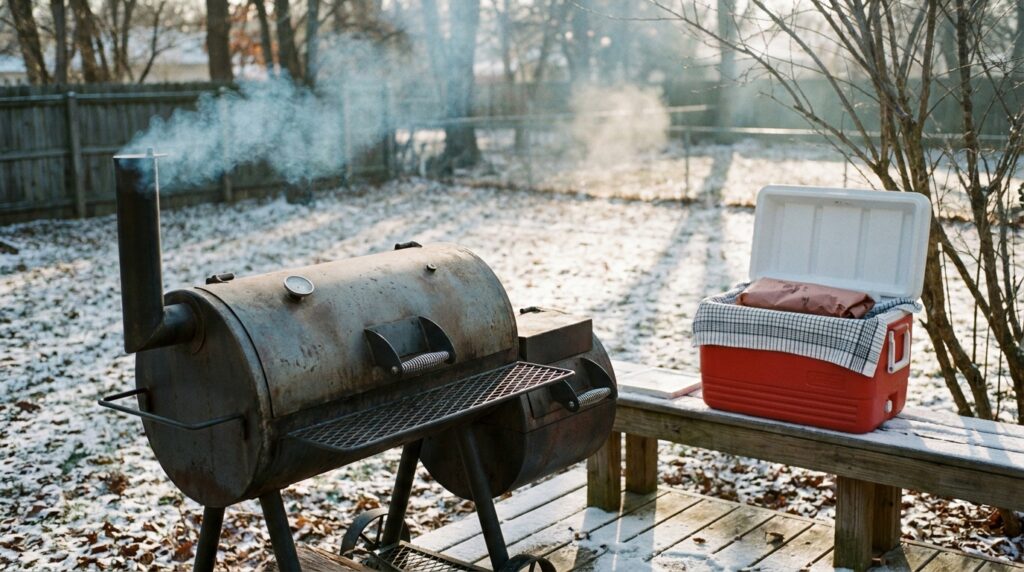
Last winter I ran a 13 pound packer on an offset, 225°F pit temp, ambient around 30°F with a steady wind across the firebox side. The chart said roughly 16 hours. It stalled at 158°F for close to five hours and finished at 19 hours, three past plan. Nothing was wrong with the brisket. The wind was pulling heat off the cook chamber and the collagen was doing what collagen does. That gap is why I now build a three hour buffer into every long cook and plan to hold, not hustle.
The variables that move every number on this page
Charts assume a calm day and an average cut. Yours may not be either. Four things shift the finish time more than anything else.
Wrapping. Naked the whole way gives the heaviest bark and the longest cook, since evaporative cooling runs unchecked through the stall. Butcher paper breathes, so bark survives and the stall shortens. Foil is the fastest and the softest bark, because it traps steam completely. Same brisket, three different finish times.
Cold and wind. A 30°F day with wind on the cook chamber pulls heat continuously, and your pit spends fuel holding temp rather than driving it into the meat. Expect a longer cook, and check your fire more often than you would in July.
Thickness and trim. Spatchcocking a bird flattens it into an even slab and cuts the cook. Trimming a thick fat cap or squaring a brisket flat changes how deep the heat has to travel. Since thickness matters far more than weight, every knife decision is a timing decision.
Holding: the buffer that makes any plan work
A faux Cambro, a dry cooler lined with towels, turns a long cook from a race into a schedule. Wrap the finished cut, fill the dead air with towels, and close it. Large collagen-heavy cuts like brisket and pork butt hold best and longest; lean cuts like tenderloin, pork loin and fish do not hold at all and should be rested briefly and served. Exact safe hold windows in hours depend on your cooler, your starting internal temperature and your food thermometer, so measure rather than assume, and never let a hold drift down into the danger zone unchecked.
- Pick your serving time, then subtract the high end of the estimate, not the low end.
- Add a buffer of several hours on any all-day cut, then plan to hold.
- Probe the thickest part for temperature, and on brisket probe for feel too.
- On thin cuts, set a check-in alarm well before the estimated finish.
- Keep a thermometer in the cooler during a hold and stop the hold if temp is dropping.
- Write down your actual times. Your pit runs the way it runs, not the way a chart does.
FAQ
Which meat should I smoke if I only have a few hours?
Fish or shellfish if you have under two hours, since most fish is done in 60 to 120 minutes at 225°F and shellfish in 30 minutes or less. With two to three hours, sausage links to 160°F or a whole pork loin to 145°F both work.
How long does it take to smoke meat at 225 degrees?
It ranges enormously. Fish runs 60 to 120 minutes, sausage two to three hours, a whole pork loin two to three hours, and brisket roughly 1.5 hours per pound, meaning 15 to 18 hours for a 12 pound packer.
Does smoking at 250 instead of 225 save much time?
On big cuts, yes. Brisket drops from about 1.5 hours per pound at 225°F to roughly 1 to 1.25 hours per pound at 250°F. On thin, lean cuts the difference is smaller and the risk of overshooting is higher.
Should I go by weight or by internal temperature?
Internal temperature, always. Weight-based charts are planning tools. Thickness matters far more than weight, so cook to temperature and appearance rather than the clock.
Why did my brisket take longer than the chart said?
The stall and the brisket’s own collagen move the finish time, and cold, wind and wrapping choice all stack on top. My 13 pound packer stalled five hours at 158°F in 30°F weather and finished three hours past plan. Start early and hold.
How long to smoke a whole hog?
About 9 minutes per pound of dressed weight at 250°F: roughly 11 to 12 hours for a 75 pound hog, 15 hours for a 100 pounder, and up to 18 hours for 120 pounds. Pull when the hams and shoulders probe 195 to 205°F.
Written by John Kirker, who built the first meat smoking calculator in 2011. Times come from cooks we have actually run and logged; temperature and feel decide the finish, never the clock alone.
Reviewed by John Kirker, Founder, John Kirker Inc. - last updated October 5, 2026.
Sources for this article
- Fish 60-120 min at 225F, shellfish 30 min or less (Smoked Seafood)
- Whole trout ~90 min at 225F, fillets ~60 min (Smoked Trout)
- Halibut ~75 min at 225F to 145F (Smoked Halibut)
- Salmon fillet 60-90 min at 225F, pull 145F or ~125F silky, albumin cue (Smoked Salmon)
- Pork tenderloin ~90 min at 225F to 145F, ~1 hr at 300F (Smoked Pork Tenderloin)
- Pork loin 225-250F to 145F, 2-3 hours, brine, rest 10 min, slice across grain (Smoked Pork Loin)
- Sausage 2-3 hours at 225F to 160F, low and slow vs direct heat (Smoked Sausage)
- Rabbit ~3 hours at 250F quartered (Smoked Rabbit)
Facts drawn from this site's own documented knowledge and first-hand experience.

Rated 5by 500+ users
Tagline
Other Options
The MeatSmokingCalculator will help you plan the timeline for any meal.
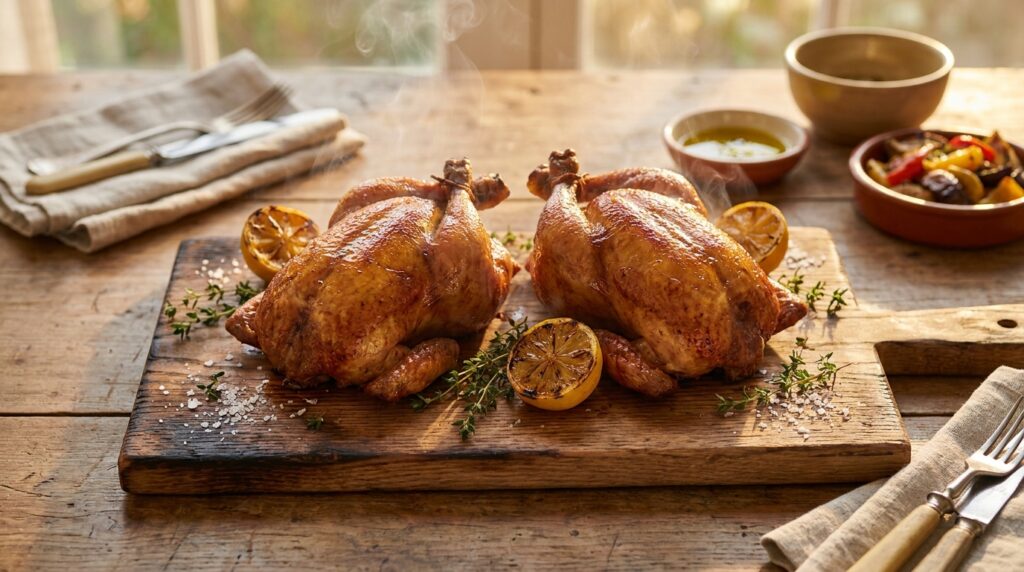
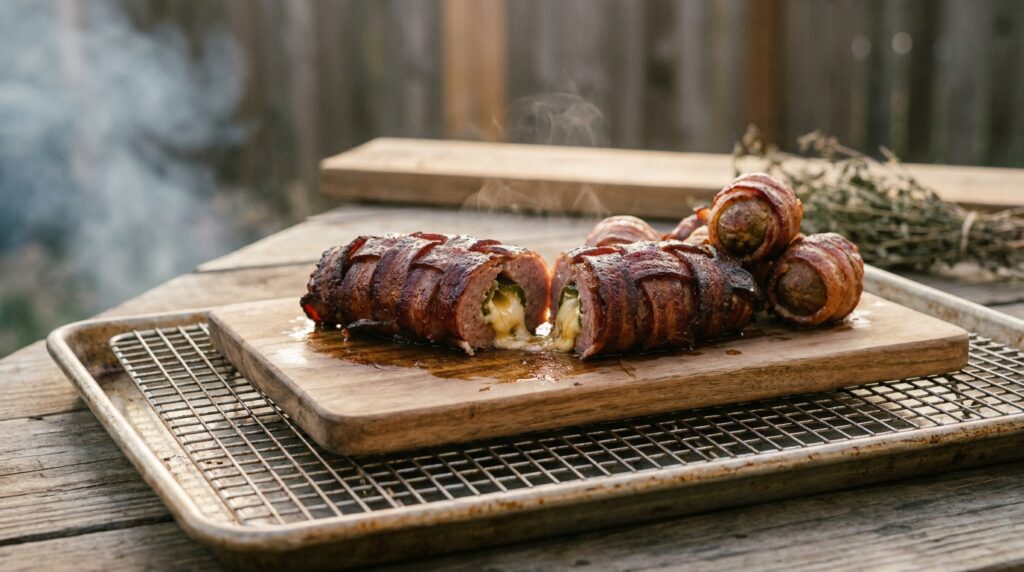
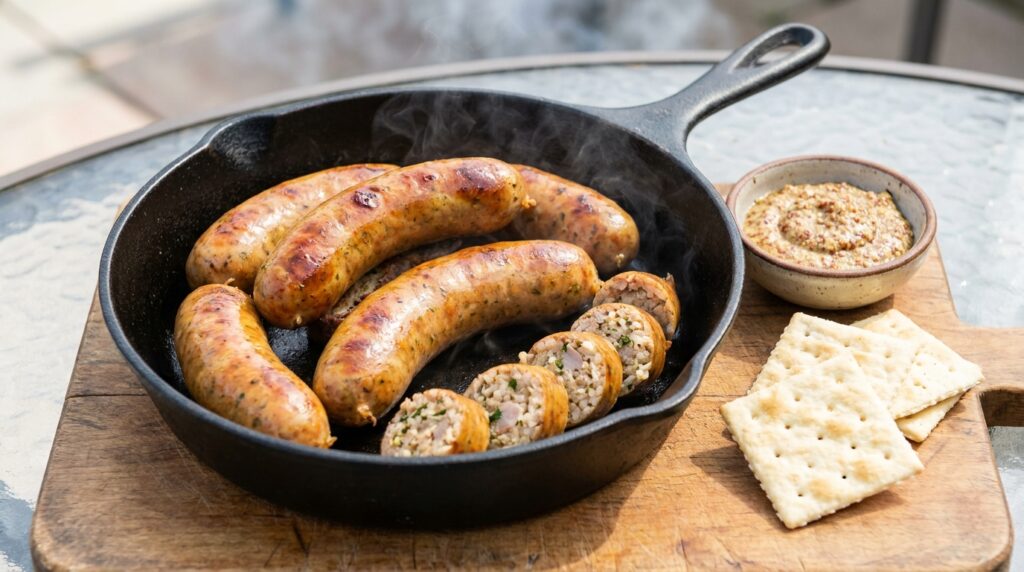
Planning, ingredients, preparation, and timing are the most critical elements to making and serving great food.
Having enough time is the most important part when it comes to slow and low!
Meat Smoking Calculator takes the thinking out of the process.
It makes cooking and serving amazing tasting smoked meats every time, on time.
SOME OF OUR FAVORITE SITES
Smoking a Turkey for Thanksgiving!
BBQ Brethren
Smoking Meat Forums
Deejay’s Smoke Pit
USDA’s Food Safety Guidelines
Smoking Pit
Virtual Weber Bullet
Smoking Times and Temps
* To help support this free site, posts contain affiliate links. If you use one of the affiliate links, we may earn a commission at no additional cost to you. As an Amazon Associate I earn from qualifying purchases.