On Time, Every Time.
How Long Does a Brisket Stall at 150 Degrees?
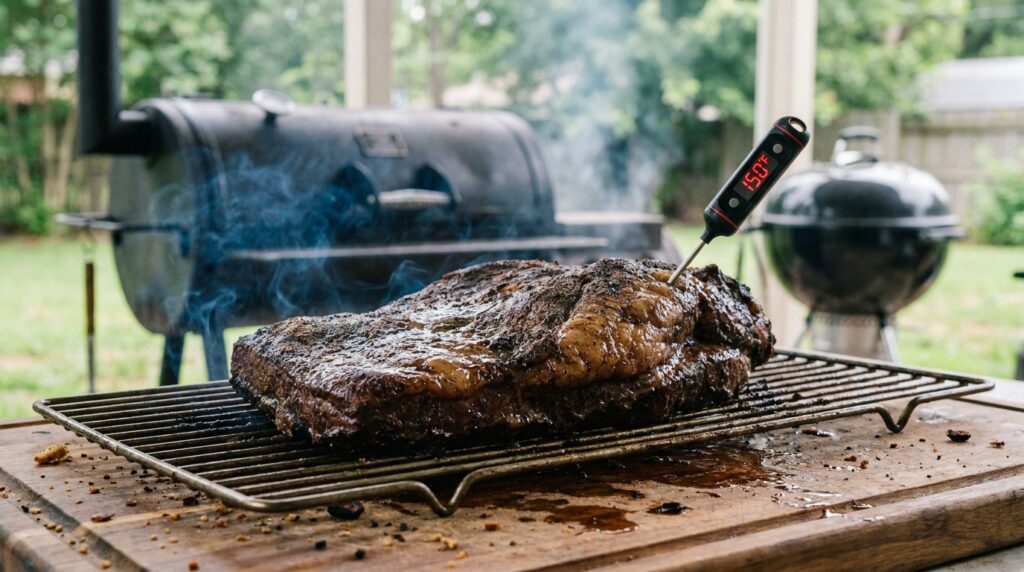
Yes, it’s completely normal. A stall at 150°F is right on schedule, and it can last anywhere from 45 minutes to six hours. What you’re seeing is evaporative cooling, not a broken smoker or a bad thermometer. Moisture leaving the brisket’s surface cools the meat at almost exactly the rate your fire is heating it, so the two cancel out and the number just sits there. It usually happens somewhere between 150 and 170°F, most often right around 160°F, but starting at 150°F is nothing to worry about. Your job now is to decide whether to wait it out or wrap.
Why the stall happens
Think of your brisket as a wet surface with a fire under it. As long as there’s moisture to evaporate off the surface, that evaporation pulls heat away just as fast as the fire adds it. The result is a temperature that stops climbing, sometimes for hours, even though your pit is running exactly where it should be. It’s the single biggest source of variance in a long brisket cook, and it’s why cooking strictly to a clock, instead of to a plan with buffer built in, tends to fail. Our full breakdown of the stall and how to beat it covers this in more depth if you want the mechanics.
How long a stall at 150°F can run
There’s no fixed number here, and that’s honest, not evasive. It depends on humidity in the pit, airflow, the size of the cut, and how much surface area is exposed. A big packer brisket in a dry, breezy pit can sit at 160°F for most of an afternoon. Starting the stall at 150°F instead of 160°F doesn’t necessarily mean it will be longer or shorter, it just means you hit the wall a little earlier. Either way, plan for 45 minutes to six hours before it breaks on its own.
Ride it out or wrap through it
You’ve got two honest options, and neither is wrong:
- Ride it out unwrapped. This gives you the best bark, but you need the time in your schedule to absorb several extra hours if you draw a long stall.
- Wrap to push through. Wrapping stops the evaporation that’s cooling the meat, so the temperature starts climbing again almost right away. Foil is fastest since it seals completely and the meat effectively braises, but it softens the bark. Butcher paper breathes, slowing evaporation without fully stopping it, so you push through while keeping most of your bark. That’s the usual compromise for brisket.
Wrap based on how the bark looks, not a specific number. It’s ready when it looks dry and doesn’t smear when you press it, which tends to land somewhere around 160 to 165°F. For the full unwrapped versus wrapped picture, our guide to how long to smoke a brisket walks through both paths start to finish, and if you’re running a pellet grill specifically, the Traeger brisket plan has the Super Smoke and wrap-timing details.
What not to do during the stall
Don’t crank the pit temperature to force it through. More heat just means more evaporation, which means more cooling, so you mostly end up with a drier surface for your trouble. Don’t spritz constantly either, every spray adds liquid that has to evaporate, which is exactly what’s holding your temperature down. Occasional spritzing for color is fine; frequent spritzing extends the stall. And don’t assume the smoker is broken and pull the meat early. A brisket pulled at 165°F is tough because the collagen hasn’t rendered yet. For food safety, brisket (and any beef you’re smoking low and slow) needs to reach a safe internal temperature before it’s food-safe to eat, but for brisket specifically you’re pushing well past that anyway, to around 203°F, for the texture you’re after.
Let the calculator absorb the stall for you
Because the stall is unpredictable by nature, the smart move is to build a buffer into your timeline rather than guess. Our calculator schedules stall time into your cook so your finish time survives it, and it can back-plan from when you actually want to eat.
If you want the full reference for other cuts and their expected ranges, check the smoking times and temperatures chart.
FAQ
Is a stall at 150 degrees too early for brisket?
No. The stall typically happens somewhere between 150 and 170°F, so starting at 150°F is within the normal range. It just means you’re hitting it slightly sooner than a stall that starts at 160°F, not that anything is wrong.
How long will my brisket stall for?
Anywhere from 45 minutes to six hours, depending on humidity, airflow, the size of the cut, and how much surface is exposed. A large packer in a dry, breezy pit can sit at the same reading for most of an afternoon.
Should I wrap my brisket to beat the stall?
Only if you need the time. Wrapping in butcher paper pushes through the stall while keeping most of your bark; foil is faster but softens it. If you have the hours to spare, riding it out unwrapped gives the best bark.
Is my smoker broken if the temperature won’t move?
Almost certainly not. A stalled temperature reading is the normal sign of evaporative cooling, not a faulty thermometer or a dying fire. Resist the urge to crank the heat or pull the meat early, both tend to backfire.
Can I speed up the stall by raising the pit temperature?
Not really. More heat drives more evaporation, and more evaporation is what’s cooling the surface in the first place, so you mostly just dry out the meat rather than actually shortening the stall.
Written by John Kirker, who built the first meat smoking calculator in 2011. Times come from cooks we have actually run and logged; temperature and feel decide the finish, never the clock alone.
Reviewed by John Kirker, Founder, John Kirker Inc. - last updated August 12, 2026.

Rated 5by 500+ users
Tagline
Other Options
The MeatSmokingCalculator will help you plan the timeline for any meal.
Planning, ingredients, preparation, and timing are the most critical elements to making and serving great food.
Having enough time is the most important part when it comes to slow and low!
Meat Smoking Calculator takes the thinking out of the process.
It makes cooking and serving amazing tasting smoked meats every time, on time.
SOME OF OUR FAVORITE SITES
Smoking a Turkey for Thanksgiving!
BBQ Brethren
Smoking Meat Forums
Deejay’s Smoke Pit
USDA’s Food Safety Guidelines
Smoking Pit
Virtual Weber Bullet
Smoking Times and Temps
* To help support this free site, posts contain affiliate links. If you use one of the affiliate links, we may earn a commission at no additional cost to you. As an Amazon Associate I earn from qualifying purchases.