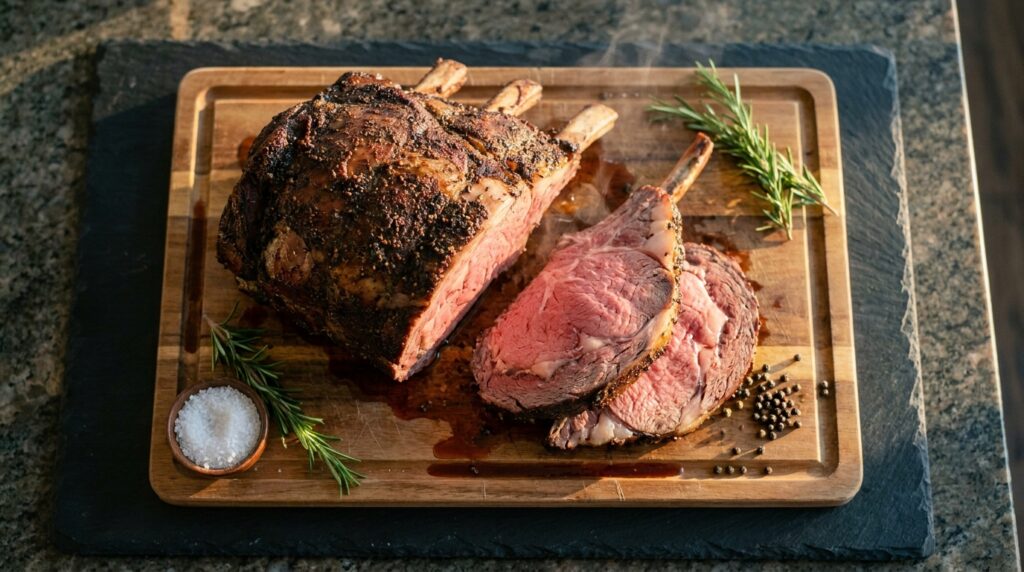
A smoked rib roast is prime rib – the name “prime rib” comes from the rib primal, not the USDA grade. The standing rib roast at your butcher counter marked USDA Choice is the same cut most steakhouses carve as “prime rib,” and it smokes exactly the same: about 40 minutes per pound at 225°F to a rosy medium-rare. Set your serve time below and work backward.
How long to smoke a rib roast
Low and slow at 225°F, plan on roughly 35 to 43 minutes per pound depending on doneness: pull at 125°F for rare, 130°F for medium-rare, 140°F for medium. Carryover adds another 5 to 10 degrees while it rests, so those pull temps land the plate right where you want it. A 6 lb roast runs about 4 hours to medium-rare; a 10 pounder closer to 6 and a half. Short on time? Hot and fast at 300°F cuts it roughly in half at about 17 minutes per pound to medium-rare, trading a little smoke depth for the clock.
Rest it 30 to 45 minutes loosely tented. A rib roast holds heat like a furnace, and slicing early pours the juice you paid for onto the board.
Choice vs Prime: is the grade worth it?
USDA grades measure marbling – the intramuscular fat that bastes the roast from the inside. Prime grade is the top of the scale (roughly the top 5 percent of graded beef) and typically runs 4 to 6 dollars per pound over Choice. Choice is everything most people love about prime rib: a well-marbled roast with a big beefy crust and a juicy center. Where Prime grade earns its premium is at rare to medium-rare doneness with simple seasoning, where the extra marbling reads as plush richness in every slice. Past medium, the difference largely renders out – if your crowd likes it pink-less, save the money.
The buying calculator further down this page prices all four options – bone-in or boneless, Choice or Prime grade – with typical prices prefilled. Put in your store’s numbers and it will tell you what each one really costs per cooked pound, so the “is Prime worth it” question gets a dollars answer instead of a vibes answer.
Bone-in or boneless?
A bone-in standing rib roast is the showpiece: it stands on its own rack of bones, insulates the bottom of the roast, and carves into a caveman-worthy rib per shift-worker after the party. Plan about 1 pound of raw bone-in roast per person. A boneless ribeye roast is easier to carve and loses less to trim – figure about 3/4 pound per person – but you pay the butcher’s work in the per-pound price. Either way the cook itself is identical; the calculator above handles both.
Keep the seasoning honest
Salt the roast the night before if you can – a dry brine gives the salt time to work into a thick roast. Coarse pepper, garlic, maybe rosemary. A roast this good does not need a complicated rub; it needs time, smoke (oak and cherry are the classic pair), and a thermometer you trust.
FAQ
Is a rib roast the same as prime rib?
Yes – “prime rib” is the traditional name for a standing rib roast, taken from the rib primal. The name predates the USDA grading system and does not mean the meat is Prime grade. A USDA Choice rib roast cooked medium-rare is what most restaurants serve as prime rib.
Is USDA Prime grade worth the extra money for smoking?
If you serve rare to medium-rare and season simply, Prime grade’s extra marbling is genuinely noticeable and worth considering for a special occasion. If your crowd eats medium or beyond, or the budget is tight, Choice delivers nearly the same experience for 4 to 6 dollars per pound less. Enter both prices in the buying calculator on this page to see the real cost difference for your headcount.
What temperature do you pull a smoked rib roast?
Pull at 125°F for rare, 130°F for medium-rare, or 140°F for medium, then rest 30 to 45 minutes. Carryover cooking adds another 5 to 10 degrees after it comes off the smoker, which lands the final slice right on target.
How much rib roast should I buy per person?
About 1 pound of raw bone-in roast per person, or 3/4 pound boneless – both work out to roughly half a pound of cooked meat on the plate after trim and cook loss. The serving calculator on this page does the math for your exact headcount and appetite level.
Prime rib / standing rib roast prices this week (and the trend)
$13.85/lb average grocery feature price (week of Sep 19, 2026)
See prices for every cut → · How much should you buy? · Cooking for money? Price the whole job
Source: USDA Agricultural Marketing Service Market News weekly retail feature reports, tracked by MeatSmokingCalculator. Prices are advertised grocery features – your store will vary.
Times & temperatures
| Style | Method | Pit temp | Approx time | Pull / done temp |
|---|---|---|---|---|
| Classic | Slow and Low | 225°F / 107°C | varies | Rare 125°F · Medium-Rare 130°F · Medium 140°F · Medium-Well 150°F · Well 160°F |
| Classic | Hot and Fast | 300°F / 149°C | varies | Rare 125°F · Medium-Rare 130°F · Medium 140°F · Medium-Well 150°F · Well 160°F |
📊 See the full smoking times & temps chart for every cut →
Written by John Kirker, who built the first meat smoking calculator in 2011. Times come from cooks we have actually run and logged; temperature and feel decide the finish, never the clock alone.
Same cut, another angle

Rated 5by 500+ users
Tagline
Other Options
The MeatSmokingCalculator will help you plan the timeline for any meal.
Planning, ingredients, preparation, and timing are the most critical elements to making and serving great food.
Having enough time is the most important part when it comes to slow and low!
Meat Smoking Calculator takes the thinking out of the process.
It makes cooking and serving amazing tasting smoked meats every time, on time.
SOME OF OUR FAVORITE SITES
Smoking a Turkey for Thanksgiving!
BBQ Brethren
Smoking Meat Forums
Deejay’s Smoke Pit
USDA’s Food Safety Guidelines
Smoking Pit
Virtual Weber Bullet
Smoking Times and Temps
* To help support this free site, posts contain affiliate links. If you use one of the affiliate links, we may earn a commission at no additional cost to you. As an Amazon Associate I earn from qualifying purchases.